Options for Operators
Premium is rent. Marks are weather. Process is the grade.
Educational only. Not investment advice. Fictional names. No live broker and no real account.
Syllabus · Open week 5 on the desk · Lab · Previous · Next
Chapter 5: Volatility — The Real Product
Options for Operators · Chapter 5 Big idea: Often you are trading volatility whether you admit it or not.
Educational only. Not personalized investment advice.
Last week, delta told you about direction. Theta told you about rent. Vega was the quiet warning: if implied volatility jumps while the stock sits still, your mark still moves.
This week IV is not a side column. It is the product.
Historical vs implied
Historical volatility (HV) is how wild the stock has been (measured from past returns). Implied volatility (IV) is how wild the option market is pricing forward into the premium.
HV is a rearview mirror. IV is a price tag on uncertainty. They can disagree for long stretches. That disagreement is not a free lunch by itself — it is a question: who is wrong, and do I have a stock decision that survives either answer?
On the Schwab Greeks tab, the IV column is the market's number for that strike and expiry. On the Pricer tab, Current implied volatility is a knob you can twist for what-if. Same family of idea. Different job (live vs lab).
Why OTM puts often look "expensive"
After major crashes (especially post-1987), equity markets learned to fear left tails. The result is often an IV skew: lower strikes (especially puts) carry higher implied vol than higher strikes.
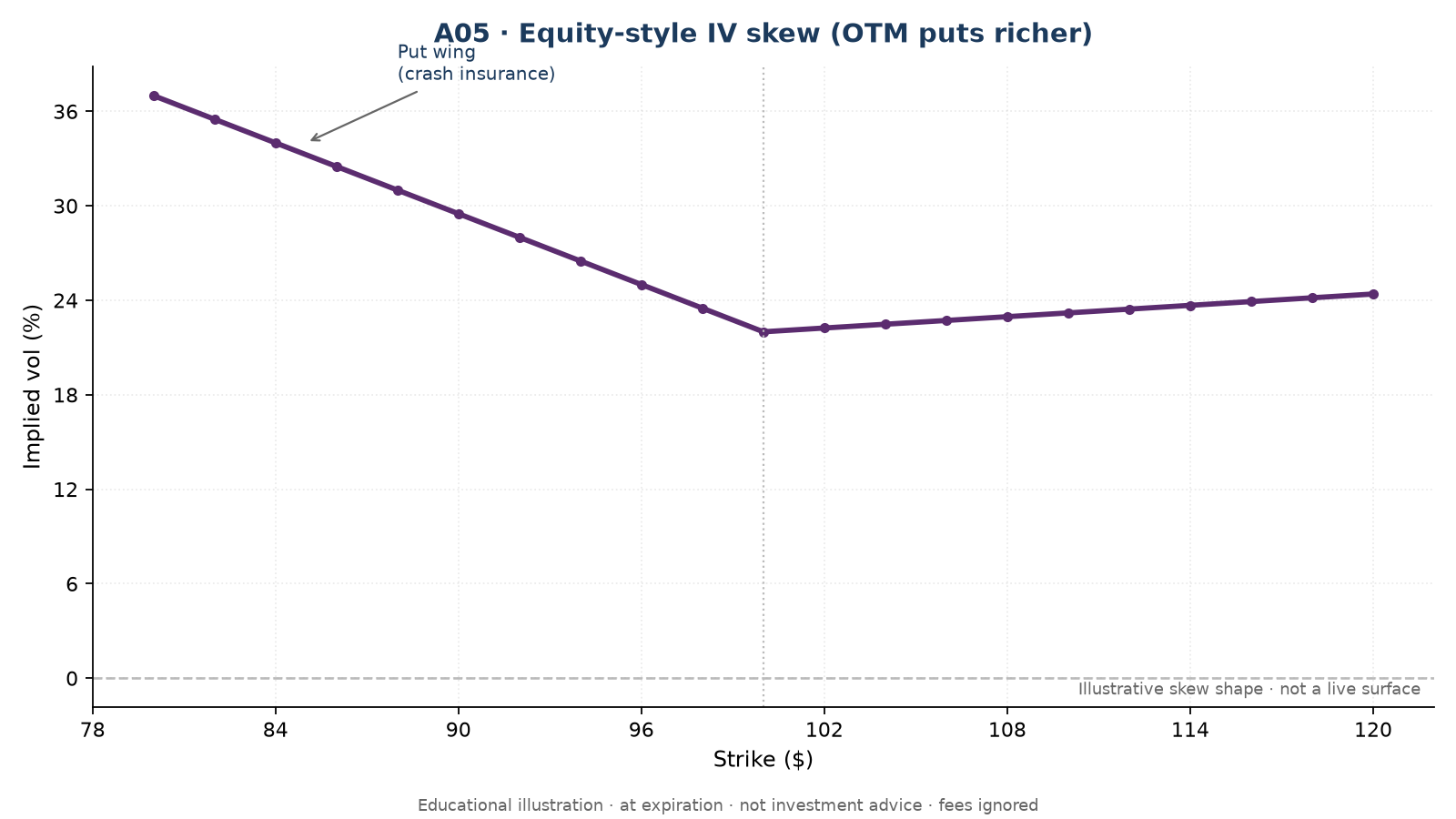
Operator read: the market charges more for crash insurance than a flat Black-Scholes world would. That does not mean "always sell puts." It means when you buy puts, you know you are often paying for a popular product. When you sell puts, you are often selling a popular product — only valid if you are a willing buyer of the stock.
Earnings and the vol crush
Before a big event, IV often rises (people pay for protection and lottery tickets). After the event, IV often falls even if the stock moves. That drop is the vol crush.
- Buy premium into the print → you can be right on direction and still lose if crush dominates.
- Sell premium into the print → you can collect crush and still get destroyed if the stock gaps through your strike.
Event premium is not a morality play. It is a sizing and thesis test.
VIX — fear index, not a crystal ball
The VIX family measures implied volatility on S&P options (roughly, expected move). High VIX = expensive index fear. Low VIX = complacency priced in.
Use: context for whether insurance is rich or cheap at the market level. Misuse: treating VIX as a timing oracle for single-name covered calls.
Long straddle: you bought a storm
Long call + long put, same strike. You need a big move. Quiet markets + time = slow bleed.
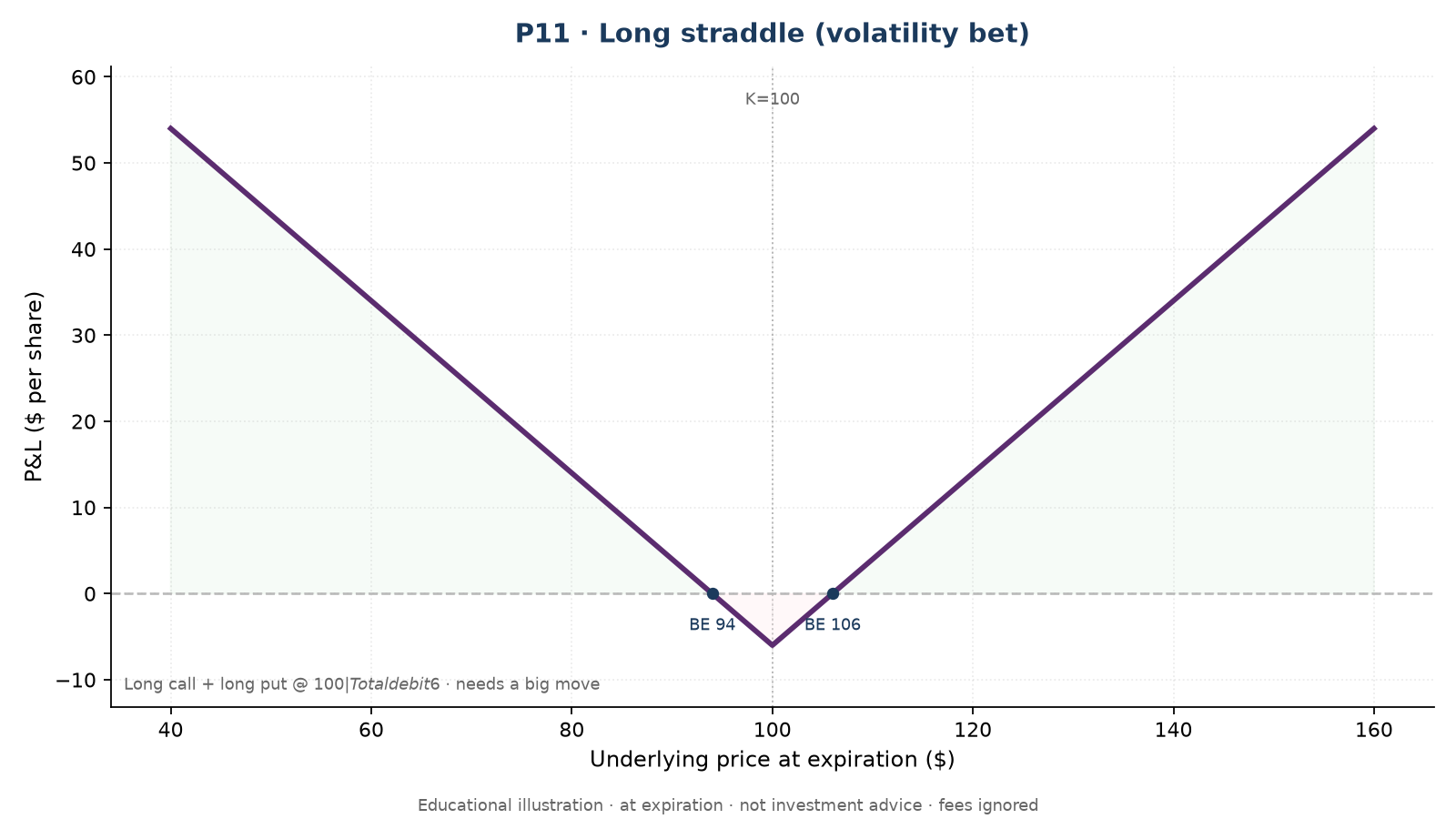
This is a volatility bet with a fuse. Not the operator default.
Short straddle: you sold the storm
Short call + short put. Max credit if the stock sits on the strike. Pain if it runs either way. Short gamma, short vega — a real job.
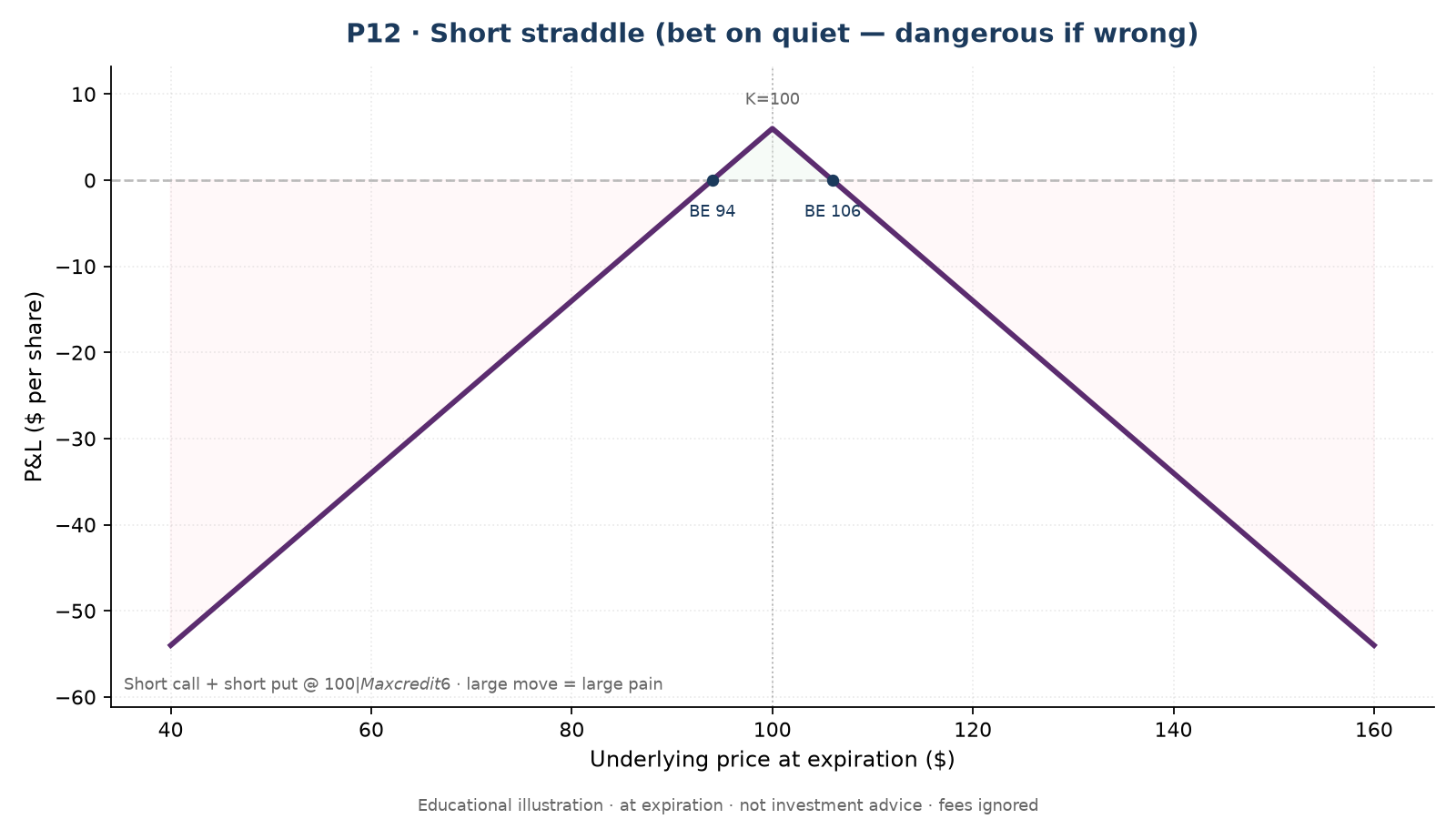
Influencer "income" content loves this shape when markets are calm. Graveyard chapters love it when markets are not. This course does not make short straddles a core tool.
When elevated IV favors writing (and when it doesn't)
Elevated IV means fatter premium for sellers. Writing can make sense if and only if:
- You already have a willing-buy or willing-sell stock decision.
- Size and collateral are real.
- You can survive IV going higher still (short vega hurts).
"IV is high" is never enough.
When cheap vol favors insurance
Low IV can mean cheaper protective puts. Taleb-style thinking: pay small for convexity when the world is complacent — if you need the floor and can afford the decay. Cheap is not free. Theta still exists.
Model reminder
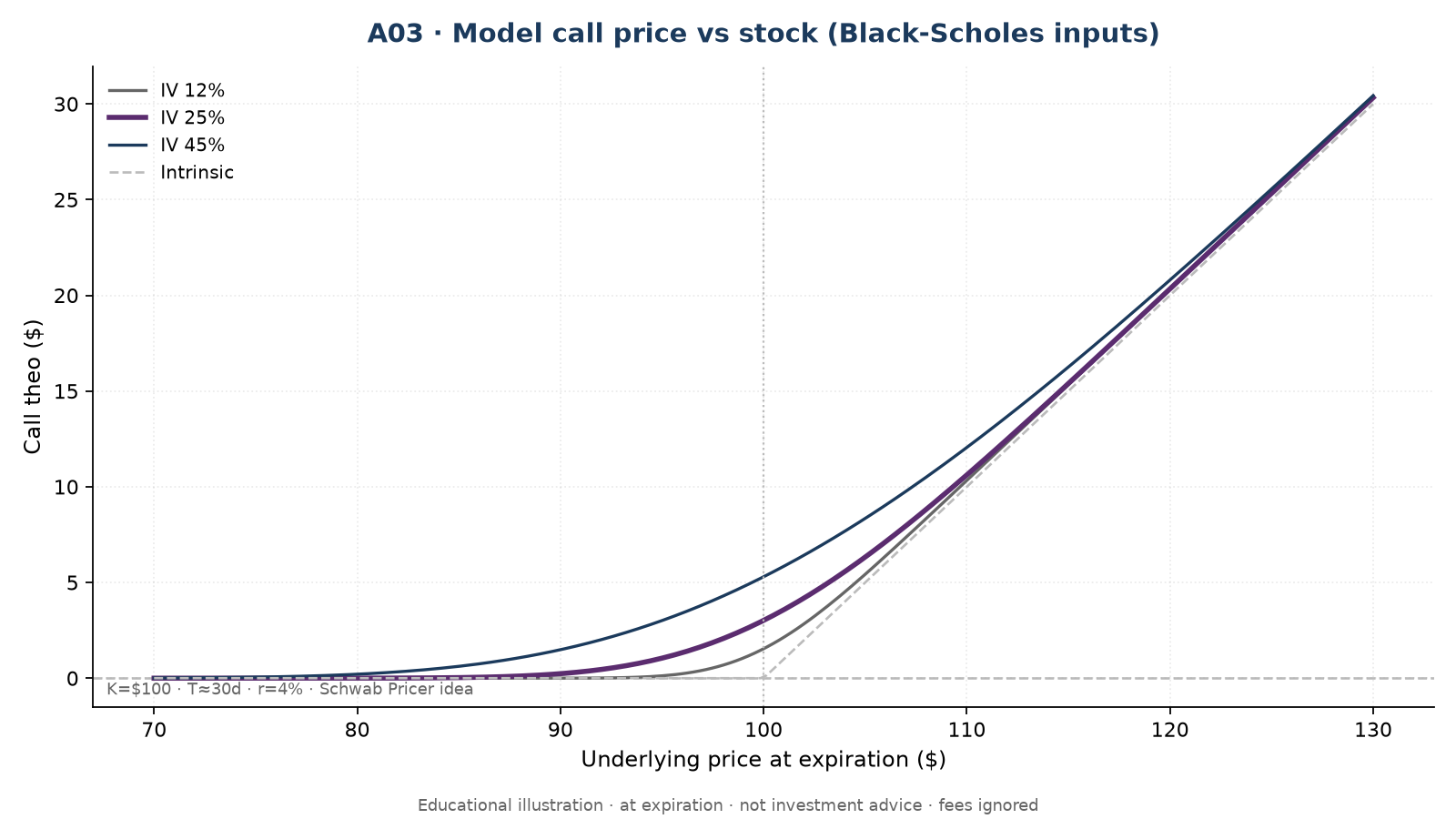
Higher IV lifts theo across the board. That is the Pricer lesson from Chapter 3 applied to today's product.
See Through It: "Sell premium because IV rank is 80"
IV rank tools are fine as weather reports. They are not permission slips. Without a strike test and rails, high IV rank just helps you get paid more to do something stupid.
Biblical thread
Uncertainty is part of creaturely life. Paying or collecting a price for uncertainty can be prudence. Pretending you tamed the future with a percentile is pride.
Takeaways
- IV is the priced storm forecast; HV is history.
- Skew often makes crash puts "rich" for a reason.
- Earnings crush can dominate direction.
- Straddles are vol bets — literacy, not default.
- Write premium only with a stock decision; buy insurance when the floor is the job.
Next: the strategy map — core four first, zoo second.
Homework
Chapter 5 Homework — Volatility (20 pts)
- (2) HV vs IV in one sentence each.
- (2) What is equity put skew in plain English?
- (3) Earnings: define vol crush; one risk for long premium; one risk for short premium.
- (2) VIX: one valid use, one misuse.
- (3) Long vs short straddle: who wants a storm? Who wants quiet?
- (4) "IV rank is high so I sell puts on any name" — rewrite as operator rule (3–4 sentences).
- (2) Greeks-tab IV column vs Pricer IV input — difference?
- (2) Reflection: when would you pay for a protective put even if IV looks rich?
Lab
Lab #5 — IV vs Reality
Chapter 5 Time: 35–50 minutes Educational only
Goal
Decide write / insure / flat using IV context + stock decision.
Tasks
- Pick 3 liquid tickers (or use frozen: A boring large-cap, a high-IV name, an index ETF).
- From Greeks tab (or frozen IV), note ATM IV for ~30 DTE if possible.
- For each: one sentence stock decision (or "none").
- Choose write premium / buy insurance / flat and justify with IV and decision.
- Sketch or reference P11/P12: when would a straddle be literacy-only for you?
Deliverable
Table of 3 names + choice + justification.