Options for Operators
Premium is rent. Marks are weather. Process is the grade.
Educational only. Not investment advice. Fictional names. No live broker and no real account.
Syllabus · Open week 4 on the desk · Lab · Previous · Next
Chapter 4: The Greeks as Decision Language
Options for Operators · Chapter 4 Big idea: Greeks are a dashboard for how the position will behave — not a personality quiz.
Educational only. Not personalized investment advice. Numbers on charts are toy or illustrative; live desk numbers move every second.
Last week you treated the Pricer as a what-if lab: change IV, price, days, hit Calculate.
This week you stay on the same Trade Builder family, but you open the Greeks tab. Same columns. Different job.
| Tab | Job |
|---|---|
| Pricer | What if I change the knobs? |
| Greeks | How does this live contract behave right now if the world moves? |
If you confuse the two, you will either manage a fantasy shock as if it were the tape, or ignore live risk because "I already ran the model at home." Operators can use both. They never swap the labels.
Why Greeks exist
An option price is a single number. That number hides several sensitivities. The Greeks pull those sensitivities into the open so you can ask better questions:
- If the stock moves $1, about how much does my option mark move? (delta)
- If the stock keeps moving, how fast does that answer change? (gamma)
- If nothing happens and a day passes, how much rent do I collect or pay? (theta)
- If the market reprices uncertainty, how much does my mark move? (vega)
- If rates shift (more relevant on long-dated options), does it matter? (rho)
You do not need to derive Black-Scholes on a napkin. You need to read a row on the desk and translate it into an operator sentence.
Delta — share-equivalent and direction
Delta is the approximate change in the option's value for a $1 move in the underlying (per share of the option's quote).
- Call deltas live between about 0 and 1 (often shown as 0.05 to 0.95).
- Put deltas live between about 0 and −1.
- ATM options often sit near ±0.50 (rough rule, not law).
- Deep ITM approaches ±1; far OTM approaches 0.
Operator translation: a call with delta 0.40 behaves roughly like owning 40 shares of exposure per contract (because one contract = 100 shares × 0.40). A put with delta −0.30 is roughly short 30 shares of exposure per contract.
If you are long the call, positive delta helps when the stock rises. If you are short the call, you are short delta — the stock rising hurts the option mark (even before assignment stories begin).
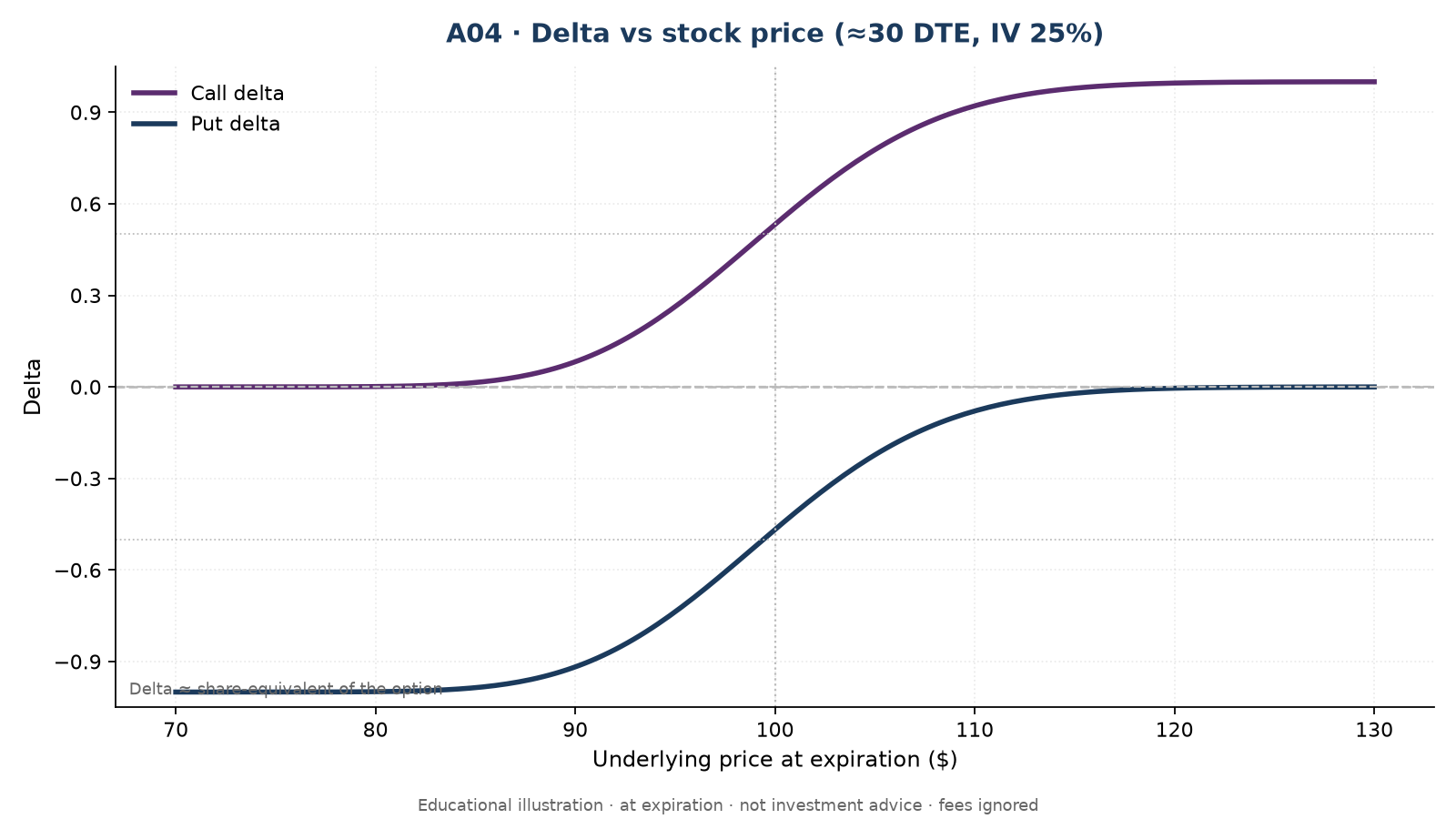
Read the chart: as the stock rises, call delta climbs toward 1 and put delta climbs toward 0 (from more negative). Location on that curve is moneyness talking.
Operator questions for delta
- Long call: "If the stock gaps up tomorrow, does this still feel like the bet I wanted?"
- Short put (CSP): "If the stock drops, my short put's mark worsens — am I still happy to buy shares at the strike?"
- Covered call: stock long delta minus short call delta = net delta still long, but less than naked stock.
Gamma — how fast delta changes (and why short gamma is a job)
Gamma measures how much delta changes when the stock moves.
High gamma means your share-equivalent is unstable. Near expiration, ATM options often have the peak gamma drama: a small stock move can flip you from "basically nothing" to "very real" exposure.
- Long options (long call or long put) are typically long gamma: the position can gain convexity in your favor when the world jumps.
- Short options are typically short gamma: when the world jumps, delta runs against you and you must manage or accept it.
You do not need to worship gamma. You need one sentence:
Short premium is a job. The job gets harder when the stock moves a lot and your short gamma is large.
That is why lottery weeklies sold for tip money are a bad job: tiny rent, violent gamma near the money near expiry.
Theta — the rent clock
Theta is the approximate daily bleed (or drip) of time value, all else equal.
- Buyers of extrinsic usually pay theta (negative theta on long options is normal).
- Sellers of extrinsic usually collect theta (positive theta on short options is normal).
You already saw the intuition chart:
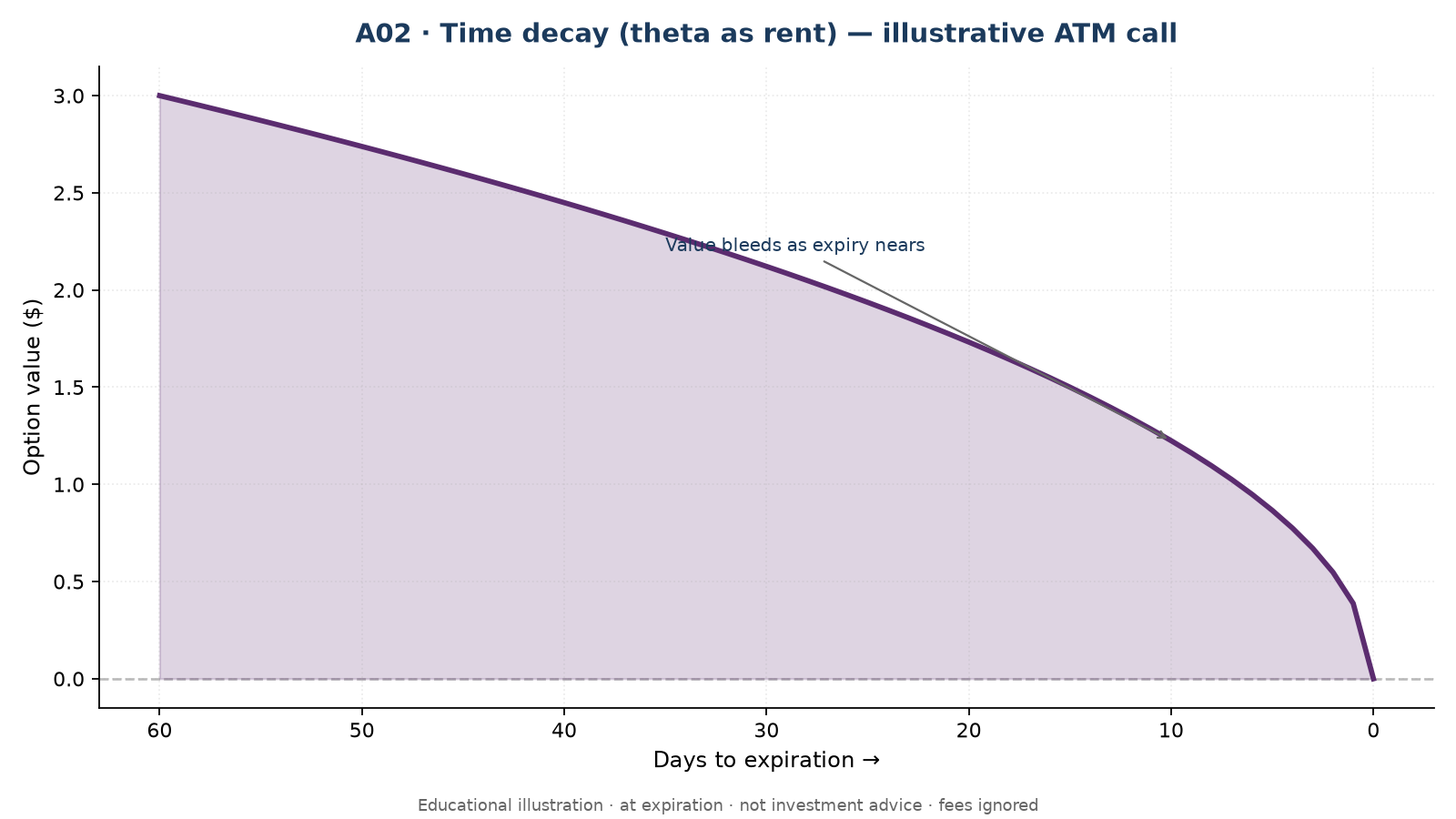
Operator translation of theta:
- Short OTM call you sold as a harvest: theta is part of why "doing nothing" can still bank premium if the stock cooperates and you stay willing.
- Long OTM call as entertainment: theta is the fuse you paid for.
Early close as theta realized
In real operator books (including the Investco-style overlay you will formalize in Module 3), short premium is often closed early when a large fraction of max credit is already banked — for example about 50% or 70% of max credit on standard legs, or about 30% on some far-OTM harvest legs. That is not magic. It is choosing to realize theta/extrinsic win and free the shares or collateral for the next decision, instead of babysitting the last pennies of premium while gamma risk returns.
Marks are still weather. Early close is a policy, not panic.
Vega — when uncertainty is repriced
Vega is sensitivity to implied volatility. If IV rises, option prices generally rise (all else equal); if IV falls, they generally fall.
- Long options: long vega (you like IV expanding after you buy).
- Short options: short vega (IV expansion hurts your mark even if the stock has not moved).
This is why earnings weeks feel weird. You can be "right" on direction and still lose if you bought premium into a crush, or be flat on the stock and still red on a short option if fear spikes.
Week 5 goes deep on IV and skew. For this week, one rule:
If you are short premium, ask: "What happens to my mark if IV jumps 5–10 points while the stock sits still?"
If you cannot stand that answer, you are not sized as an operator. You are sized as a hope.
Rho — the quiet one (until LEAPs)
Rho is rate sensitivity. For many short-dated equity options, rho is background noise. On LEAPs and rate-sensitive underlyings, it matters more. On Schwab's Greeks tab you will still see the column. Glance. Do not build your personality around it in high school or early operator books. Know it exists so nobody can bluff you with it.
Desk home this week: Schwab → Trade Builder → Greeks
Open a liquid symbol. Trade Builder. Click Greeks (not Pricer).
Typical filters (as on a real desk):
- Strikes: e.g. 8
- Expirations: e.g. 60 Days
You get stacked expirations. For each strike band:
Calls (left of strike) · Strike · Puts (right of strike)
Columns to read fluently:
| Column | Plain job |
|---|---|
| Bid / Ask | What you can actually trade |
| Theo Value | Model reference (not a fill) |
| IV | Live implied vol on that line |
| Delta | Direction / share-equivalent |
| Gamma | How jumpy delta is |
| Theta | Rent clock (sign depends on long/short) |
| Vega | IV sensitivity |
| Rho | Rates (secondary for most of this course) |
Job of this tab: How does this contract behave if the stock, time, or vol moves — right now?
Compare one ATM call on the front expiration to the same strike-ish line 30–60 days out. Longer-dated options usually show different theta/vega balances. That is the desk teaching duration without a lecture.
Three positions, three greek stories
You already know these payoff shapes at expiration. Greeks explain the path before that day.
Long call
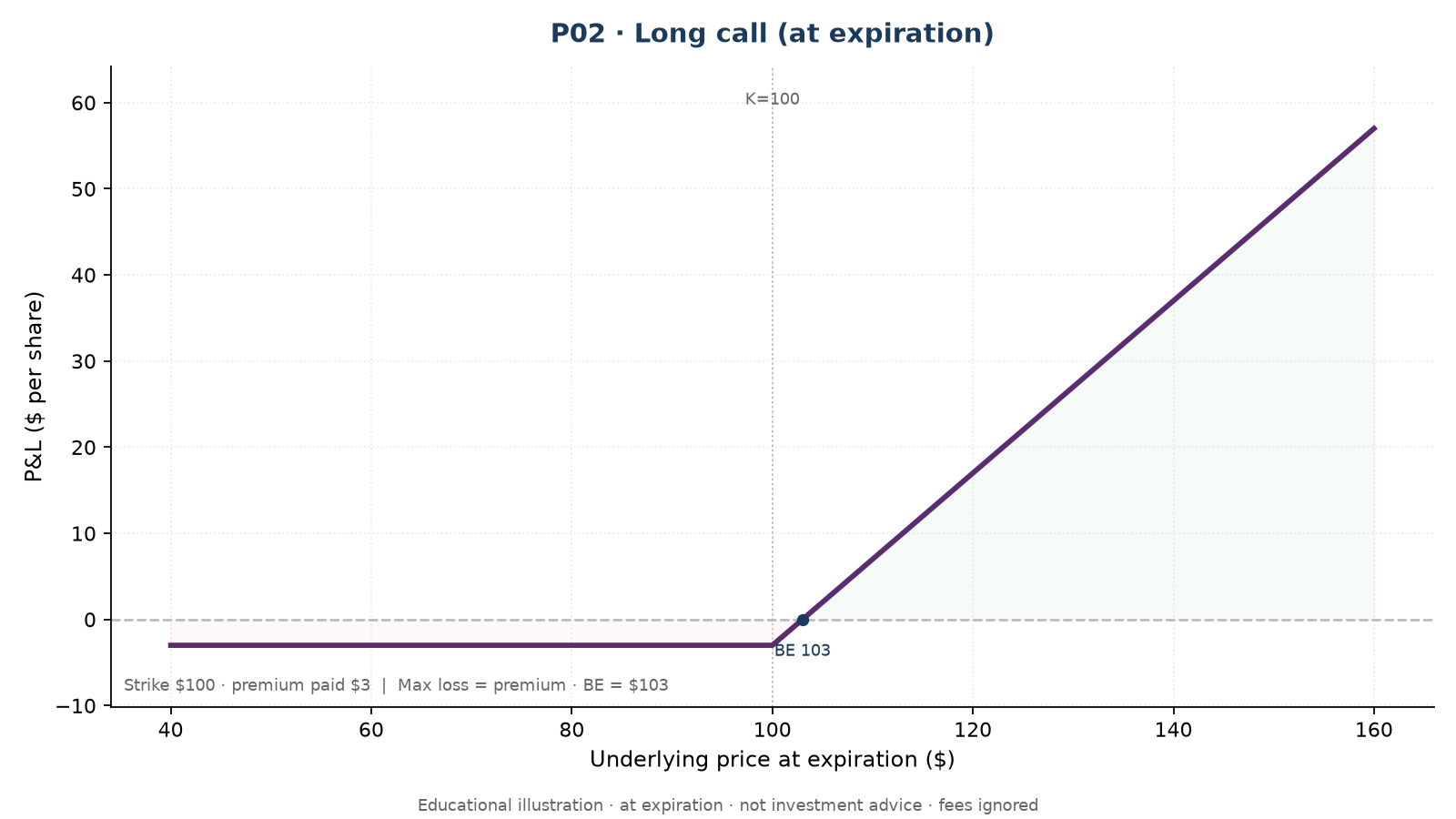
- Delta: positive (you want the stock up)
- Gamma: long (big jumps can help)
- Theta: usually against you
- Vega: long (IV up helps the mark)
Short put (CSP shape)
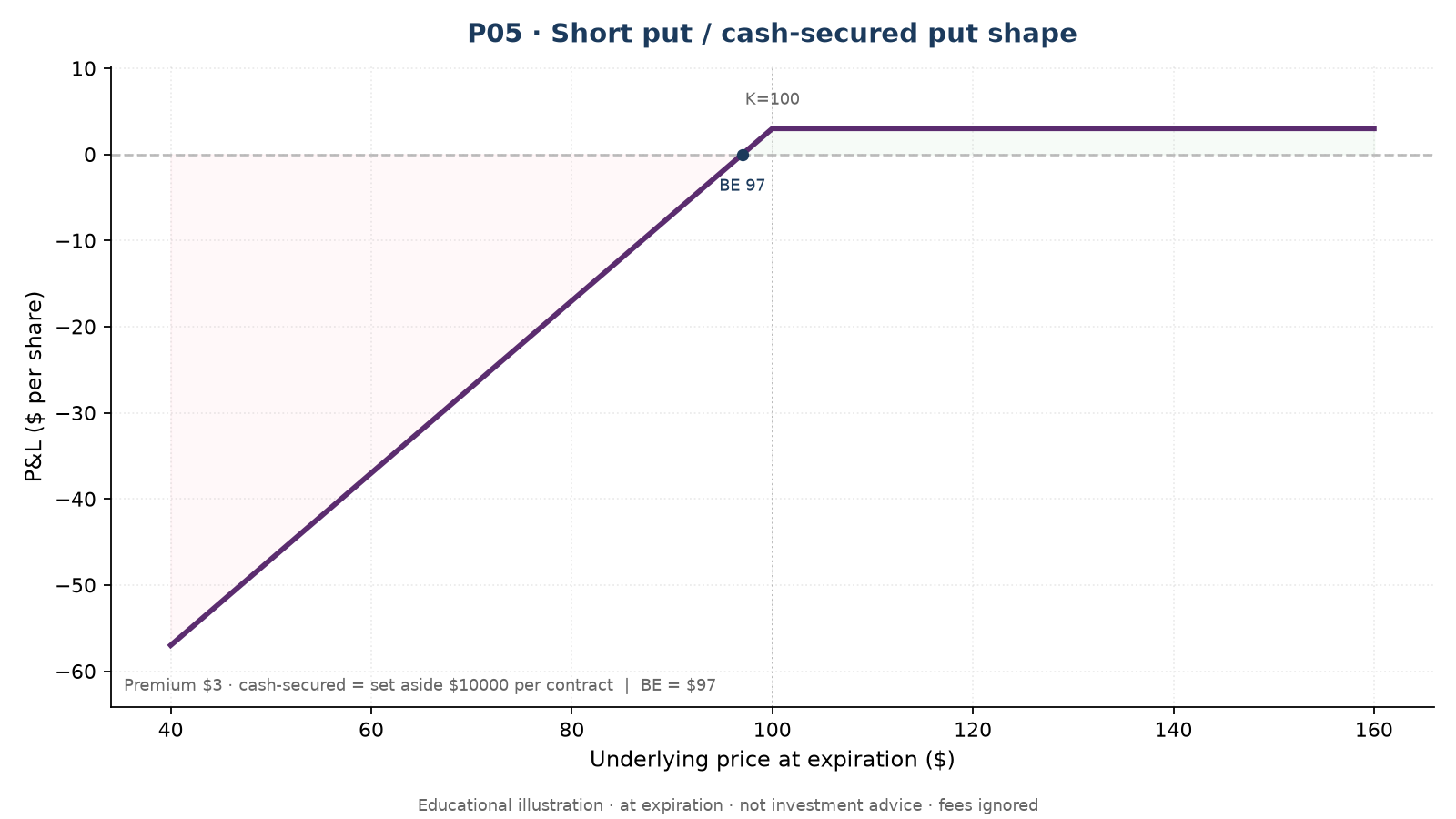
- Delta: negative (stock down hurts the mark; assignment path opens)
- Gamma: short (jumps down make the job harder)
- Theta: usually with you while OTM
- Vega: short (fear spike hurts the mark)
Remember: you only sell this if you are a willing buyer at the strike. Greeks describe the weather on the way. They do not replace the strike test.
Covered call (stock + short call)
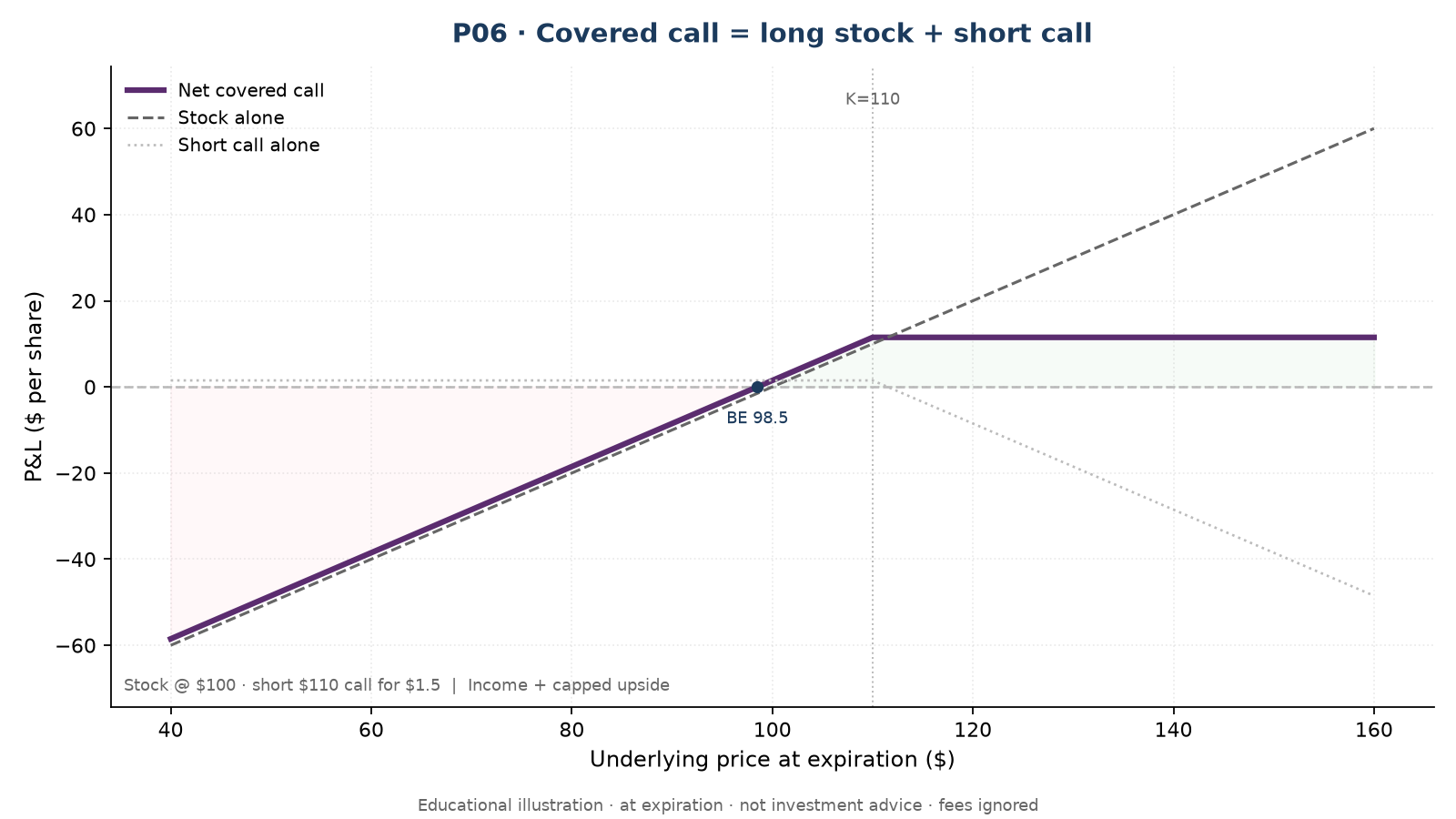
- Net delta: still long, but reduced by the short call's delta
- Short call gamma/vega/theta: you are the premium seller on that slice
- Stock remains the main risk if the name collapses — the short call does not insure the downside
If you only watch the short call's theta and ignore the stock, you are managing a side show.
Single-name vs book Greeks
One contract's delta is a line item. A book of five short puts and two covered calls has a net delta, net vega, net theta. Professional desks sum them.
For this course:
- Master one row on the Greeks tab.
- Then ask: "If I add a second short put, what happens to my assignment cash and my net short delta?"
- Portfolio Greek dashboards in software (Investco-style) are the grown-up version of that question. You will not need code this week. You need the habit.
See Through It: Greek-speak as status theater
You will meet people who say "I'm short gamma" the way others say "I'm in finance."
Greek words without:
- a max loss in dollars,
- a willing-buy/sell strike,
- and a size that cannot break the household
…are cosplay.
Also watch for false precision: delta 0.3721 on a wide market is a model whisper, not a commandment. Use Greeks to rank risks and ask better questions. Do not use them to pretend uncertainty left the building.
Biblical thread: measures that tell the truth
Honest weights and measures show up again and again in Scripture because false scales steal. Greeks are a modern measuring language for contingent promises. Using them to see risk is prudence. Using them to impress or to deny obligation is a false scale.
"Differing weights are an abomination to the Lord, and false scales are not good" (Proverbs 20:23 ESV).
Lab teaser
Lab #4: Greeks Dashboard — Copy live (or frozen) ATM call/put greeks on two expirations. Write one operator question per Greek. Map long call / short put / covered call to which Greek dominates the job.
Takeaways
- Greeks translate one price into behavior under shocks.
- Delta ≈ share-equivalent; know the sign of your side.
- Gamma makes short premium a job when markets jump.
- Theta is rent; early close can be realized rent with a policy.
- Vega is the fear/complacency reprice.
- Schwab Greeks tab = live dashboard; Pricer = what-if. Do not swap them.
- Greek fluency without a stock decision is still gambling with better vocabulary.
Next chapter: volatility as the real product — IV, skew, and when "cheap" or "rich" options are a trap.
Homework
Chapter 4 Homework — The Greeks
20 points · Educational only
A. Definitions (6 pts)
- (2) In one plain sentence each, what do delta and theta measure?
- (2) Why is short gamma described as a "job" in this chapter?
- (2) What does vega tell you that delta does not?
B. Signs and sides (4 pts)
- (2) You are long a call with delta 0.45. Stock jumps +$2 (all else equal, rough). Does your option mark tend to rise or fall? About how much per share if delta stayed constant?
- (2) You are short a put. IV spikes while the stock price is unchanged. Does your short put mark tend to help you or hurt you? Which Greek is the main language for that?
C. Desk literacy (4 pts)
- (2) Name two differences between Schwab's Greeks tab and Pricer tab.
- (2) List the column names on a Greeks-tab row that this course expects you to read fluently (at least six).
D. Position mapping (4 pts)
- (2) For a covered call, which risk does the short call not fix if the stock collapses?
- (2) Match: long call / short CSP-style put — which is typically long vega, which short vega?
E. Shock table (2 pts)
- (2) For each shock, name the Greek you check first and whether a short call mark usually benefits or suffers (assume still OTM, rough):
a) Stock rips higher b) One week passes, stock flat, IV flat c) IV jumps, stock flat
(At least one answer must explicitly name a Greeks-tab column.)
Lab
Lab #4 — Greeks Dashboard
Chapter 4 · The Greeks Time: 40–50 minutes Primary surface: Schwab Trade Builder → Greeks (not Pricer)
Goal
Read a live Greeks-tab row fluently and turn each Greek into one operator question.
Path A — Live Schwab
- Pick a liquid large-cap (or a name you already use for homework; educational only).
- Open Trade Builder → Greeks.
- Set something like Strikes = 8, Expirations = 60 Days (or closest filters).
- Build this table in a spreadsheet:
| Expiry | Type | Strike | Bid | Ask | Theo | IV | Delta | Gamma | Theta | Vega |
|---|---|---|---|---|---|---|---|---|---|---|
| Near (weekly or front) | Call ATM-ish | |||||||||
| Near | Put ATM-ish | |||||||||
| ~30–60 DTE | Call ATM-ish | |||||||||
| ~30–60 DTE | Put ATM-ish |
- Operator questions — write one sentence per Greek using the longer-dated call row:
- Delta → "If stock +$1 …" - Gamma → "If stock keeps moving …" - Theta → "If nothing happens for a day …" - Vega → "If IV +5 points …"
- Position sketch (no orders):
- Long that call — which Greek helps you, which hurts you? - Short the put (CSP idea) — which Greek is the job? - Covered call (own stock + short the call) — what is net story in one sentence?
- Optional: flip to Pricer, raise IV 10 points, Calculate, compare theo to the Greeks-tab live theo. One sentence on the difference.
Path B — No Schwab (frozen twin)
Use these illustrative rows (stock ~$100, not live):
| Expiry | Type | Strike | Mid | IV | Delta | Gamma | Theta | Vega |
|---|---|---|---|---|---|---|---|---|
| 7 DTE | Call | 100 | 2.10 | 28% | 0.52 | 0.08 | −0.09 | 0.07 |
| 7 DTE | Put | 100 | 2.05 | 29% | −0.48 | 0.08 | −0.08 | 0.07 |
| 45 DTE | Call | 100 | 4.20 | 26% | 0.51 | 0.03 | −0.04 | 0.14 |
| 45 DTE | Put | 100 | 4.00 | 27% | −0.49 | 0.03 | −0.04 | 0.14 |
Complete steps 5–6 from Path A using the 45 DTE call for the four operator questions.
Deliverable
- Completed table
- Four operator questions
- Three position sketch sentences
No trades required.
Link forward
Chapter 5 treats the IV column and skew as the main product. Keep this sheet; you will add an IV-vs-strike wing read next.