Options for Operators
Premium is rent. Marks are weather. Process is the grade.
Educational only. Not investment advice. Fictional names. No live broker and no real account.
Syllabus · Open week 3 on the desk · Lab · Previous · Next
Chapter 3: Pricing Intuition (Without Worshipping the Model)
Options for Operators · Week 3 Big idea: Premium is driven by time, volatility, and the underlying. Models help. They don't replace judgment.
Educational only. Not personalized investment advice.
Last week you learned what a contract is. This week you learn why it costs what it costs — and how to use the broker's Pricer tab as a what-if lab instead of a crystal ball.
If Week 2 was the wiring diagram, Week 3 is the weather report. You still have to decide whether to leave the house.
Buyers pay for a story. Sellers collect rent on a promise.
When you buy an option, you pay premium for:
- A chance the underlying moves your way (direction)
- Enough time for that move to show up
- Enough uncertainty (volatility) that the move is plausible
When you sell an option, you collect that premium because you are willing to take the obligation. In this course, you only do that when the obligation matches a stock decision you already hold (willing buyer / willing seller). The premium is rent for standing ready — not a salary from the universe.
Time decay: the fuse you can see
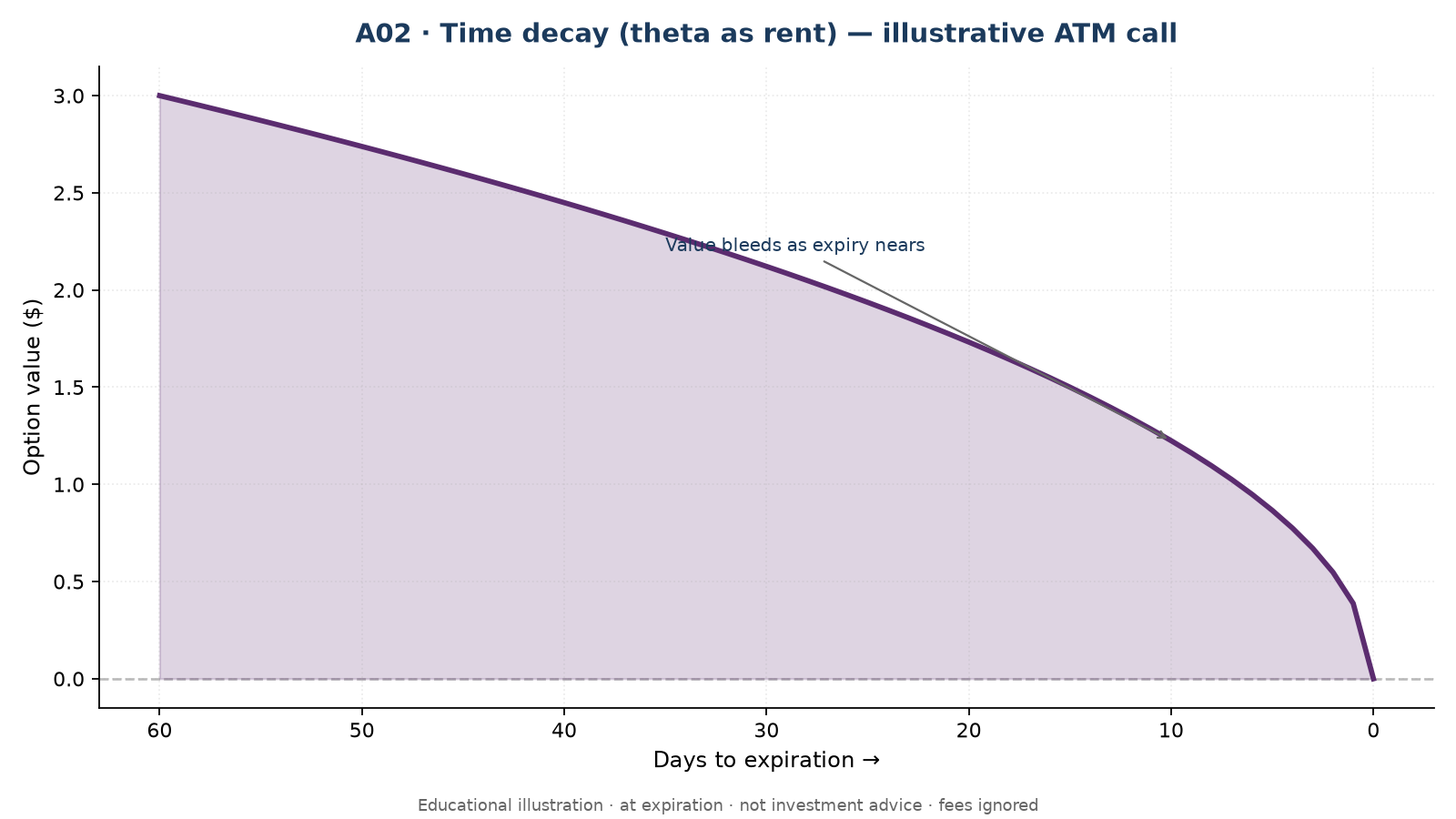
Extrinsic value does not like calendars. All else equal, options lose time value as expiration approaches. That bleed is theta in Greek-speak (next week). For now, feel it as rent running in favor of the seller of extrinsic and against the buyer.
Two operator notes:
- Time decay is not free money. You are being paid because you took a risk.
- Decay speeds up into the final weeks for many ATM options. "I'll wait until the last day to buy a lottery call" is often how the house wins.
Volatility: the weather priced in
Historical volatility is how wild the stock has been. Implied volatility (IV) is how wild the option market is pricing going forward.
IV is not a prophecy. It is a price of uncertainty embedded in premium. When IV is high, options are expensive (good for sellers if you have a stock decision and can stand the risk). When IV is low, insurance can be cheaper (good for buyers of puts if you actually need the floor).
You will abuse this idea if you treat "high IV" as an automatic sell signal on names you do not want to own or sell. Process first. Weather second.
Black-Scholes as a story of inputs (not a religion)
In Advanced Finance you met the Black-Scholes name next to LTCM: brilliant models, still-mortal humans. For operators, BS is a story with knobs:
| Input | Plain English |
|---|---|
| Stock price (S) | Where the underlying is |
| Strike (K) | The promise price |
| Time (T) | How long until expiration |
| Volatility (σ) | How jumpy we assume the world is |
| Rate / dividend | Smaller knobs for many equity trades; matter more on LEAPs |
The model spits out a theoretical price ("theo"). Markets show bid/ask. When they disagree, someone is wrong, someone is illiquid, or someone knows something the simple model doesn't (skew, event risk, borrow hard-to-locate, etc.).
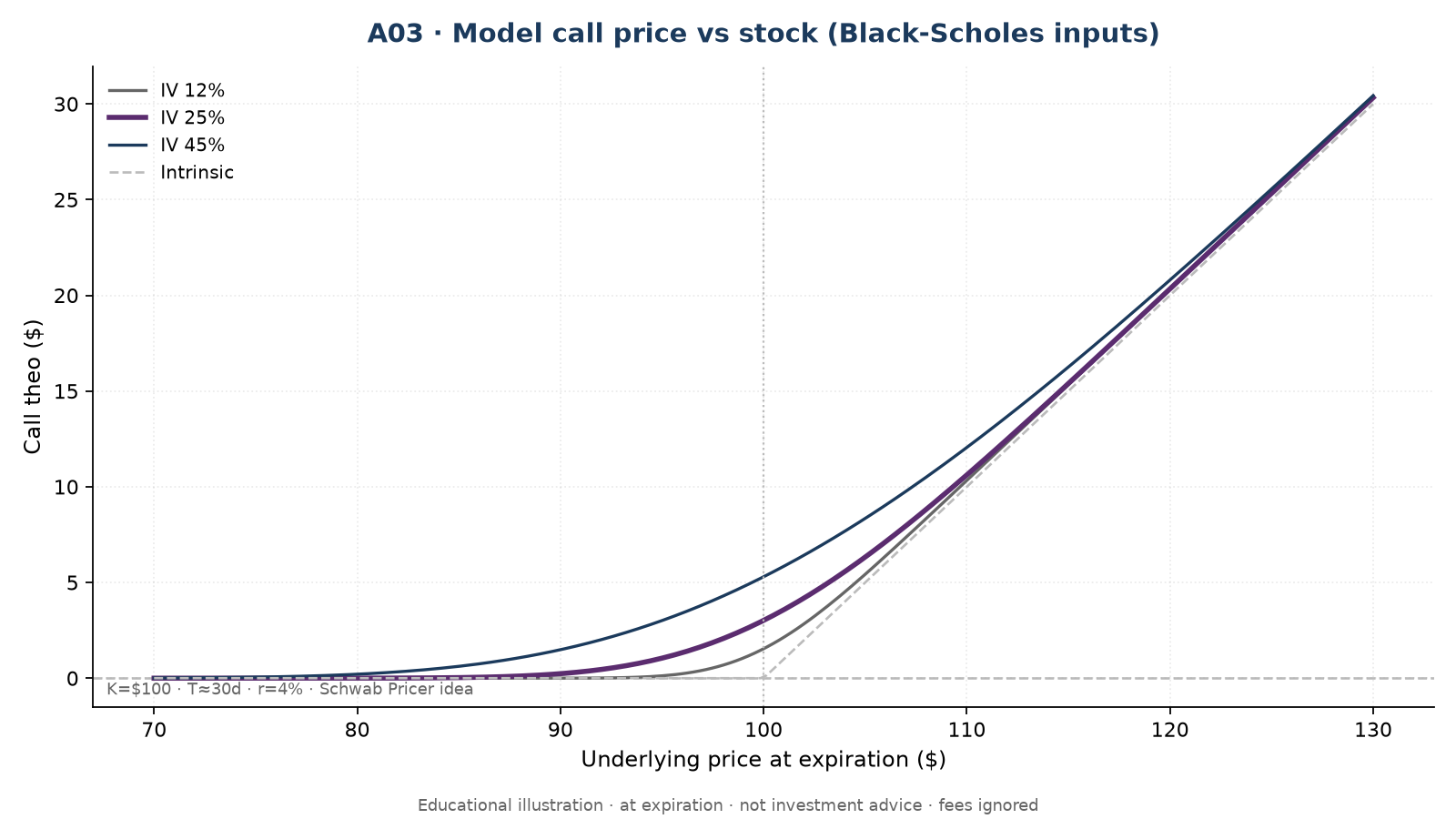
Read the chart: same call, higher IV → higher theo across the stock axis. Raising IV is like turning up the storm forecast. The Pricer tab lets you turn those knobs on purpose.
Schwab Trade Builder → Pricer (your lab home this week)
On Schwab's web platform, open a liquid symbol → Trade Builder → Pricer tab.
You should see controls like:
- Strikes (how many lines)
- Strike to center on
- Expiration date
And a row of model inputs:
| Field | What to play with |
|---|---|
| Current implied volatility | Raise/lower 10 points and recalculate |
| Underlying price | Shock ±5% without waiting for the tape |
| Days to expiration | Walk DTE toward zero |
| Interest rate | Leave default on first pass |
| Annual dividend yield | Nonzero later on dividend names |
| Calculate | Always re-run after edits |
The grid then shows Bid, Ask, Theo Value, IV, Delta, Gamma, Theta, Vega, Rho for calls and puts — the same family of columns as the Greeks tab, but driven by your inputs, not only the live feed.
Job of the Pricer: What does the model think this contract is worth if one knob moves? Job it does not have: Tell me what to trade.
Desk drill (do this once)
- Center on a liquid large-cap (or a high-IV name if you want drama).
- Note ATM call theo.
- Raise IV ~10 percentage points → Calculate → journal what happened to call and put theo.
- Reset; drop DTE toward 0 → journal extrinsic death.
- Reset; move underlying +5% → journal call vs put.
If you cannot open Schwab, use the charts in this chapter and Lab #3's spreadsheet twin. Same questions.
Fair value vs the market: the spread is real
Suppose theo says $3.40 and the market is $3.10 × $3.70.
- If you buy at $3.70, you start "behind" theo.
- If you sell at $3.10, you also start "behind" mid.
On liquid names the tax is small. On sleepy LEAPs it can be a whole thesis. Operators use limits near mid and walk away when the market is a canyon. Market orders into wide markets are how you donate to market makers.
Long call again: what premium bought you
You already know the expiration hockey stick.
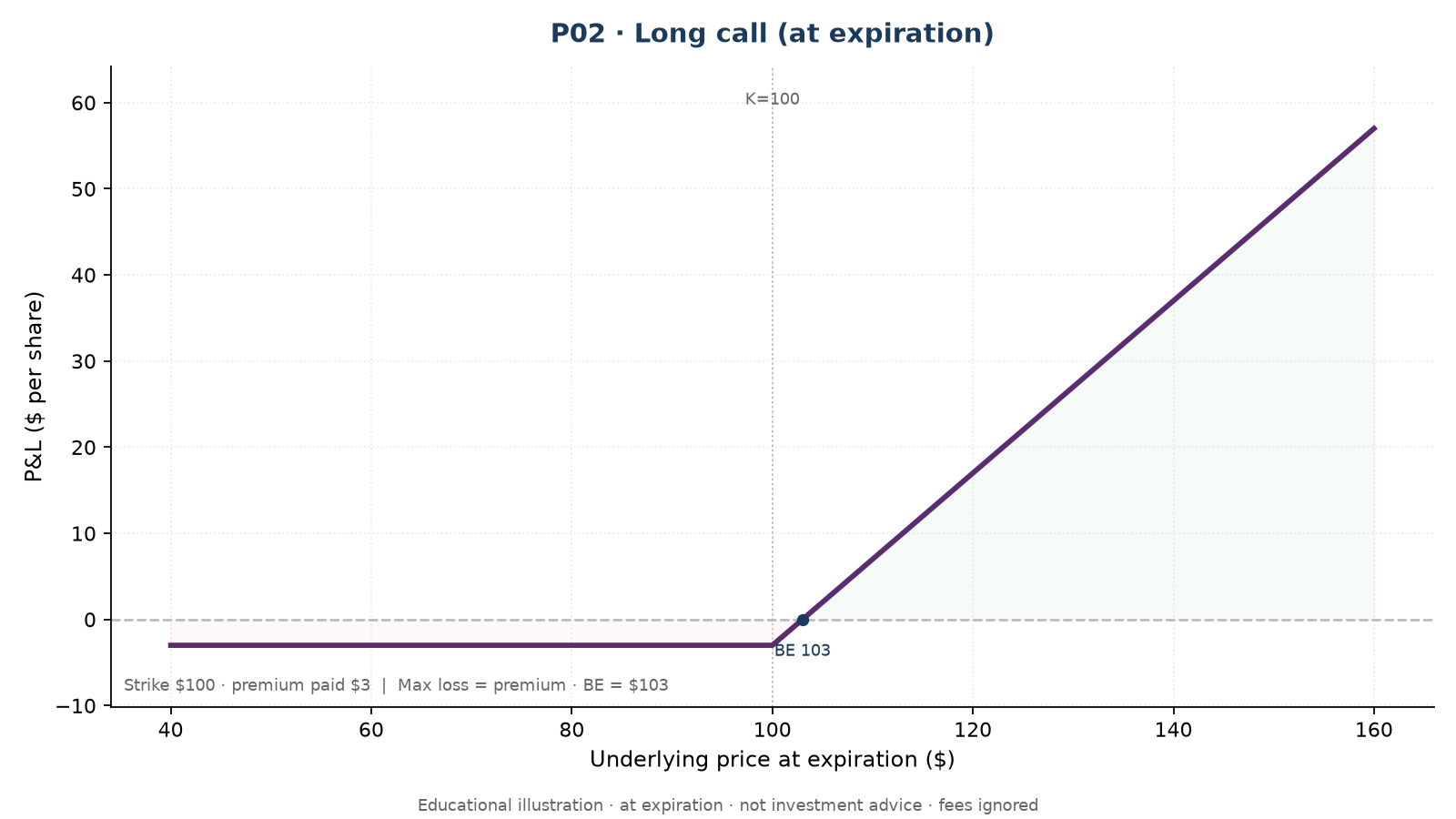
Before expiration, the live mark is not that final shape. It is a blend of intrinsic and remaining extrinsic. That is why marks feel like weather: the chart you settle into at expiration is a destination, not the path. Week 4's Greeks explain the path. Week 10's hold rules refuse to panic on the path when the stock decision is intact.
Intrinsic vs extrinsic (pricing lens)
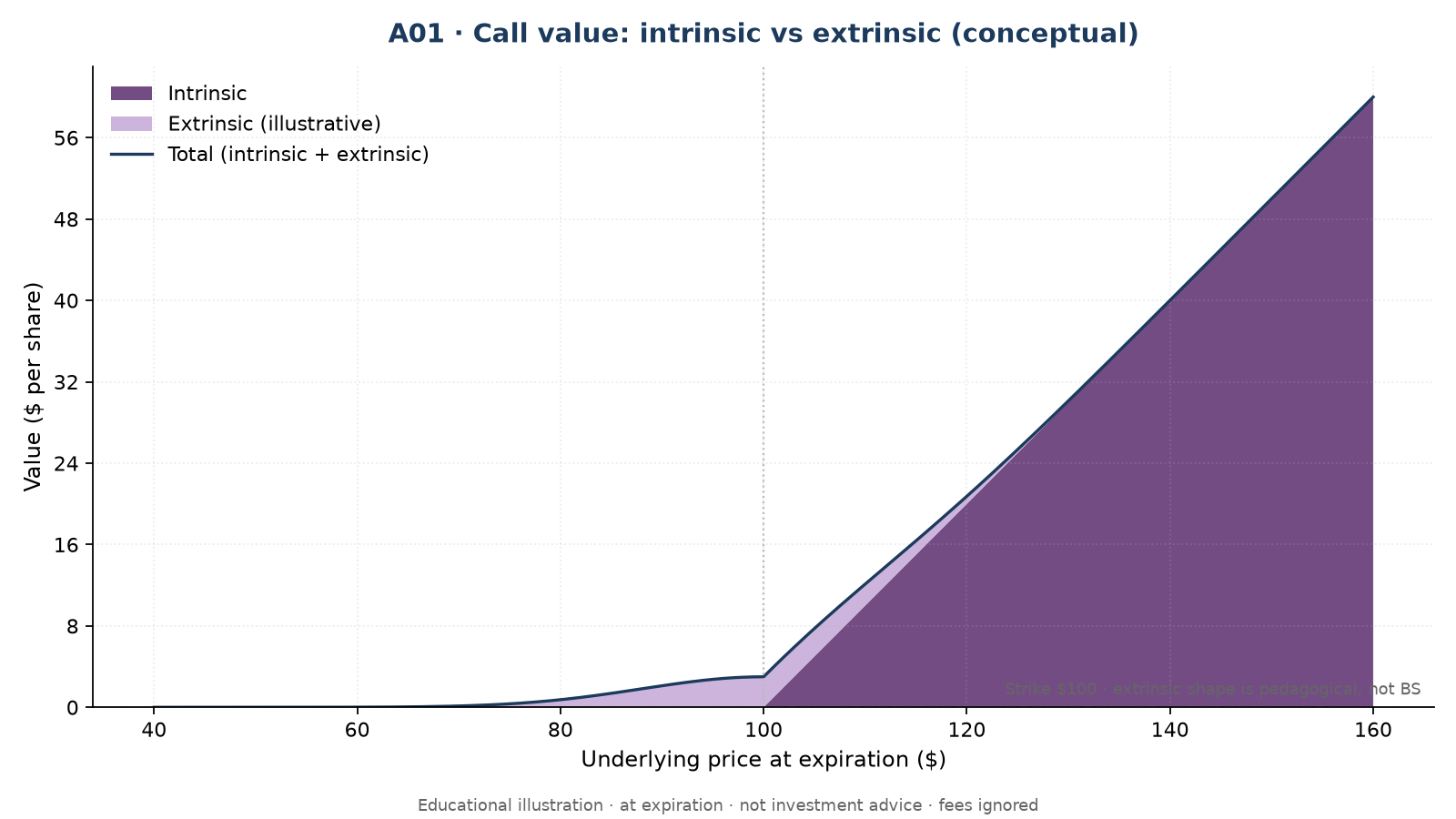
Sellers of far OTM premium are usually selling almost pure extrinsic. If that premium is tip money after fees, the operator skips. Investco's harvest playbook learned this the hard way on low-IV names: near-term far OTM calls paid noise; a longer-dated call at the true happy-sell strike sometimes paid real rent. That is a pricing observation in service of a stock decision — not a new personality as an "options trader."
See Through It: "The model says it's cheap"
Models can say something is cheap while:
- You cannot exit the spread
- Earnings are tomorrow and IV will crush
- You have no willing-buyer/seller reason to hold the risk
- The skew makes "cheap" calls and "expensive" puts a single surface, not a free lunch
LTCM did not die because the formula forgot how to multiply. Humans stacked leverage on model comfort. Advanced Finance already taught you that pattern. Do not reenact it with three contracts in a retirement account.
Biblical thread: false precision
There is a kind of pride that loves decimal places. Scripture is less impressed by precision theater than by honest weights and measures.
A theo value to four decimals is not holiness. A clear strike test is: Would I buy (or sell) the shares at this price if assignment or exercise happened tomorrow?
Lab teaser
Lab #3: Pricer Sandbox — Change S, IV, and DTE on Schwab Pricer (or the twin sheet). Journal three ahas. No orders required.
Takeaways
- Premium prices time and uncertainty, not just direction.
- Theta is rent; IV is the storm forecast in the price.
- Black-Scholes is a knob story; IV is often the interesting knob.
- Schwab Pricer is a what-if lab; Greeks (next week) is the live dashboard.
- Bid/ask can matter as much as theo.
- Models without process are how smart people still get hurt.
Next week: the Greeks as decision language — and the Schwab Greeks tab as your morning panel.
Homework
Chapter 3 Homework — Pricing Intuition
20 points · Educational only
- (2) In plain English, what is implied volatility pricing?
- (2) Who tends to benefit from pure time decay, all else equal: the buyer or the seller of extrinsic premium?
- (3) List five Black-Scholes-style inputs and one sentence each on what they do to call prices when they rise (direction is enough).
- (3) Schwab Pricer vs Greeks tab: which is what-if, which is live dashboard? Why does the distinction matter?
- (3) Theo mid is $2.00; market is $1.70 × $2.40. Explain one risk of buying at the ask and one risk of selling at the bid.
- (3) Long call, strike $100, premium $3. At expiration stock is $99. P&L per share? Why is "almost there" still a full loss of premium?
- (2) Give one example of treating the model as a religion (bad) vs a tool (good).
- (2) Reflection: If IV doubles overnight on a stock you short-called as a willing seller, what do you check first — the mark or the stock decision? Why?
Lab
Lab #3 — Pricer Sandbox
Week 3 · Pricing Intuition Time: 40–50 minutes Primary surface: Schwab Trade Builder → Pricer (or spreadsheet twin)
Goal
Feel how theo and greeks columns move when you change IV, price, and time — without placing a trade.
Path A — Live Schwab
- Open a liquid symbol (large-cap preferred; high-IV name optional second pass).
- Trade Builder → Pricer.
- Set strikes count ~8, center near the money, pick ~30 DTE if available.
- Record ATM call and ATM put: Bid, Ask, Theo, IV, Delta, Theta, Vega.
- Experiments (Calculate after each; reset between):
- Underlying +5% - Underlying −5% - IV +10 percentage points - DTE toward 0 (or shortest available)
- Journal three "aha" sentences. One must mention bid/ask vs theo.
Path B — No Schwab (twin sheet)
Use reading charts A02, A03, and P02. Answer:
- If IV rises, do option prices generally rise or fall?
- As DTE → 0, what happens to extrinsic on an OTM option?
- Why can "theo" and "what I can trade" differ?
Still write three ahas.
Deliverable
One page journal (or sheet screenshot) + three ahas. No orders.
Link forward
Week 4 uses the Greeks tab on the same symbol family — live columns without you editing IV by hand.