Options for Operators
Premium is rent. Marks are weather. Process is the grade.
Educational only. Not investment advice. Fictional names. No live broker and no real account.
Syllabus · Open week 2 on the desk · Lab · Previous · Next
Chapter 2: Anatomy of a Contract
Options for Operators · Week 2 Big idea: Every option is a priced promise with five knobs.
Educational only. Not personalized investment advice. Charts are at-expiration illustrations using toy numbers (stock at $100) so the math stays clean.
You've already met options in Advanced Finance (the Alternatives week). Call. Put. Premium. Strike. That was the postcard.
This week is the wiring diagram.
If you skip the anatomy, every "strategy" video on the internet will sound like a language you almost speak. You'll nod at "delta" and "assignment" without feeling them in your hands. Operators don't nod. Operators can take a single line on a broker chain and say: what is this promise, who owes what, what can I lose, and what has to be true for me to accept it?
That's the job for the next few pages.
The promise in one sentence
An option contract is a standardized agreement that gives the buyer a right (not an obligation) and gives the seller an obligation if that right is used.
- Buy a call → you may buy 100 shares at the strike by expiration.
- Buy a put → you may sell 100 shares at the strike by expiration.
- Sell either one → you take the other side of that promise, and you get paid premium for standing ready.
The unit of account in U.S. equity options is almost always 100 shares per contract. When you see a premium of $3.00, the cash that changes hands is about $300 per contract (before fees), not $3.
Write that on a sticky note. Premium quotes are per share. Your wallet thinks in contracts × 100.
Five knobs (and one hidden sixth)
Every listed option is defined by:
| Knob | What it means |
|---|---|
| Underlying | The stock or ETF the contract references (e.g. a company ticker) |
| Type | Call or put |
| Strike | The fixed price in the promise |
| Expiration | The last day the promise is alive (plus exercise rules) |
| Premium | The price of the promise right now (bid/ask in the market) |
The sixth thing is not printed as a "field," but it runs everything: side. Are you long (bought) or short (sold) the contract? Same printed line on the chain. Opposite jobs.
American-style equity options (the usual stock options in a U.S. brokerage) can usually be exercised any time before expiration. European-style (common on some indexes) only at expiration. You don't need a law degree. You need to know which world you're in before you sell something.
Long stock: the baseline chart
Before options, know what "own the shares" looks like as a payoff line. Buy stock at $100. At any later price S, your P&L per share is simply S − 100.
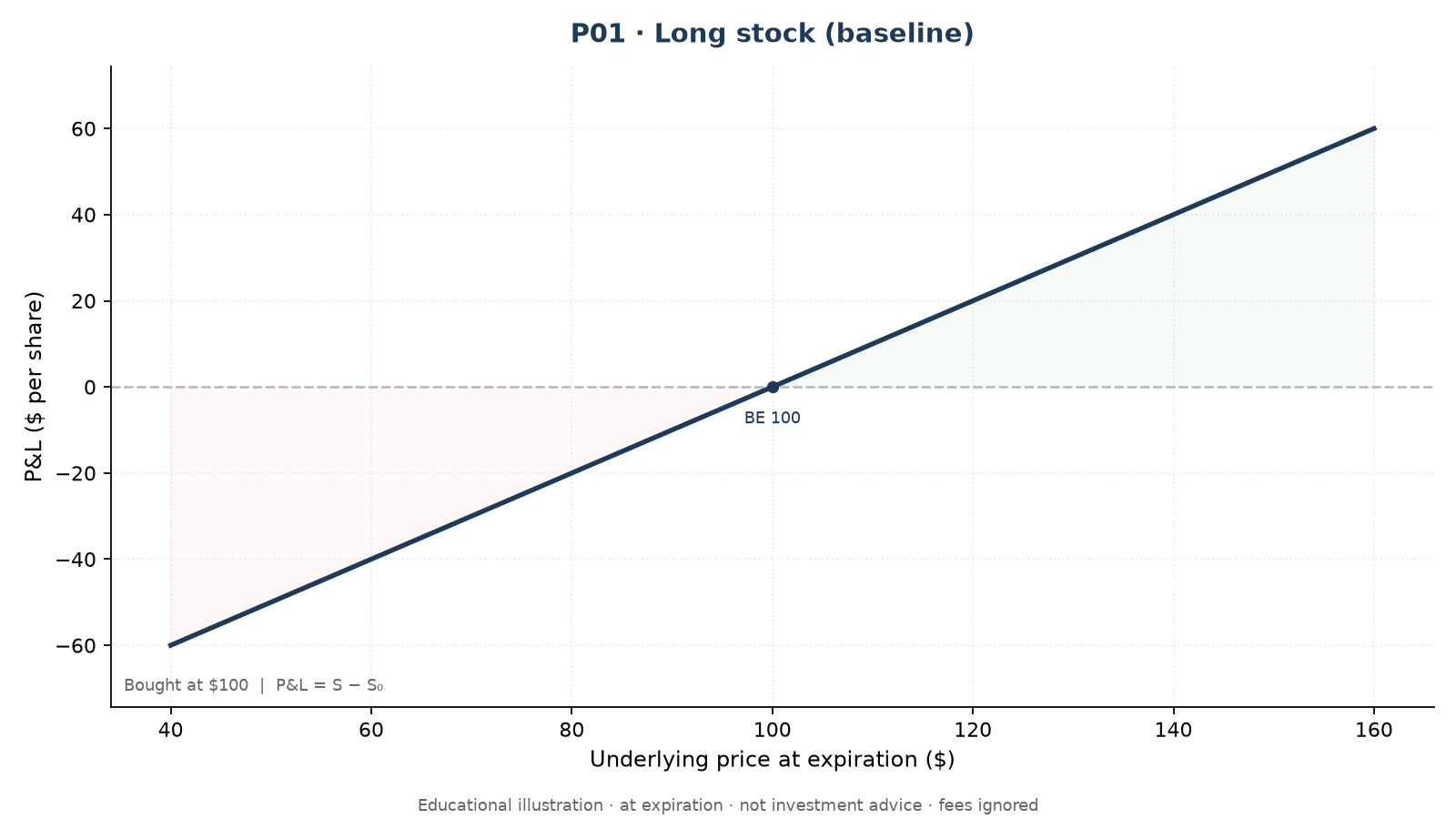
Unlimited upside (in theory). Downside all the way to zero. No fuse. No expiration on the shares themselves (you can hold for decades). Options add shape and time on top of this world.
Long call: the hockey stick
You buy a call with strike $100 and pay $3 premium.
At expiration:
- If the stock is below $100, the call is worthless. You lost the $3.
- If the stock is above $100, the call is worth the intrinsic value S − 100. Your net is (S − 100) − 3.
- Breakeven is $103 (strike + premium paid).
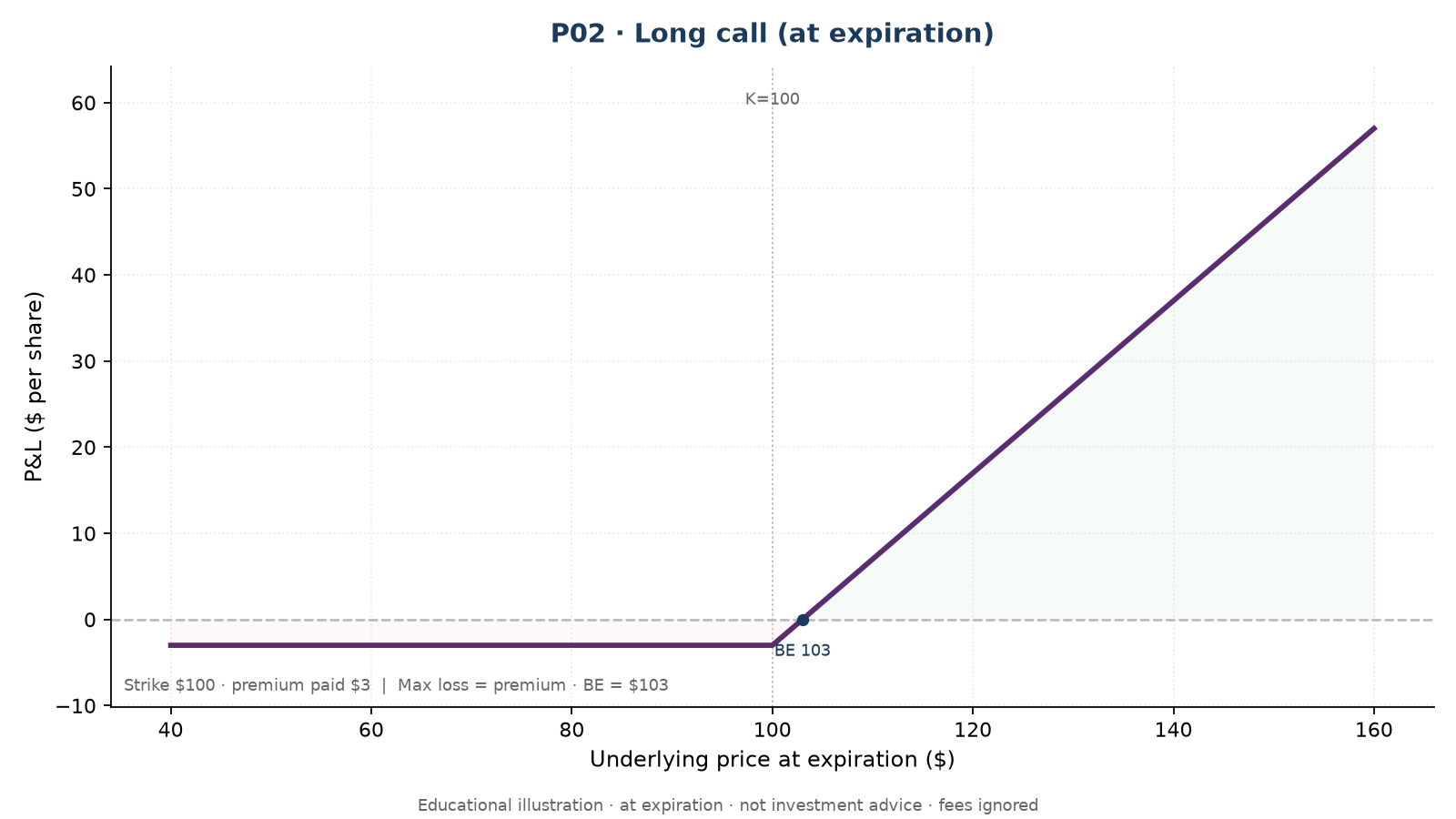
Read the chart left to right:
- Flat loss floor (you only lost what you paid).
- A kink at the strike.
- A rising line that eventually goes green past the breakeven.
That limited-loss, open-upside shape is why people call long calls "asymmetric." It is also why they are perfect lottery tickets when used without a stock decision. Asymmetry is not the same as wisdom.
Long put: insurance shape
You buy a put with strike $100 and pay $3.
At expiration:
- If the stock is above $100, the put expires worthless. You lost $3.
- If the stock is below $100, the put pays 100 − S. Net: (100 − S) − 3.
- Breakeven is $97.
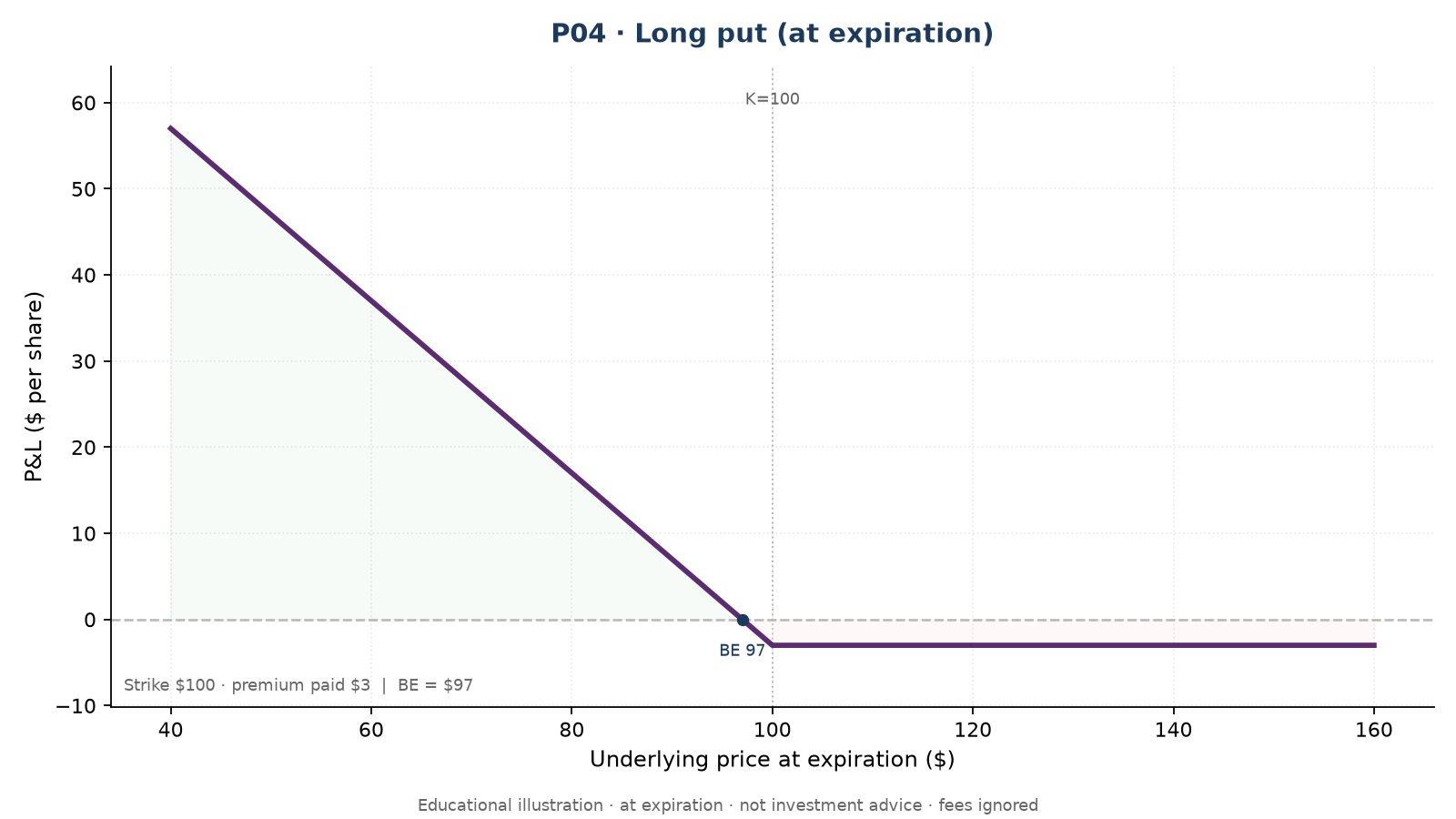
This is the shape of portfolio insurance when you already own the stock (we'll combine legs later). Alone, a long put is a defined-risk way to bet on a decline. Alone without a thesis, it's still a fuse burning toward expiration.
Short put: the cash-secured put shape
Flip the long put. You sell the $100 put and receive $3.
At expiration:
- If the stock stays above $100, you keep the $3. Max gain = premium.
- If the stock is below $100, you are obligated to buy 100 shares at $100 (if assigned). Your economic entry is about $97 after the premium.
- The loss deepens as the stock falls (you are buying something that's cheaper in the market than your strike).
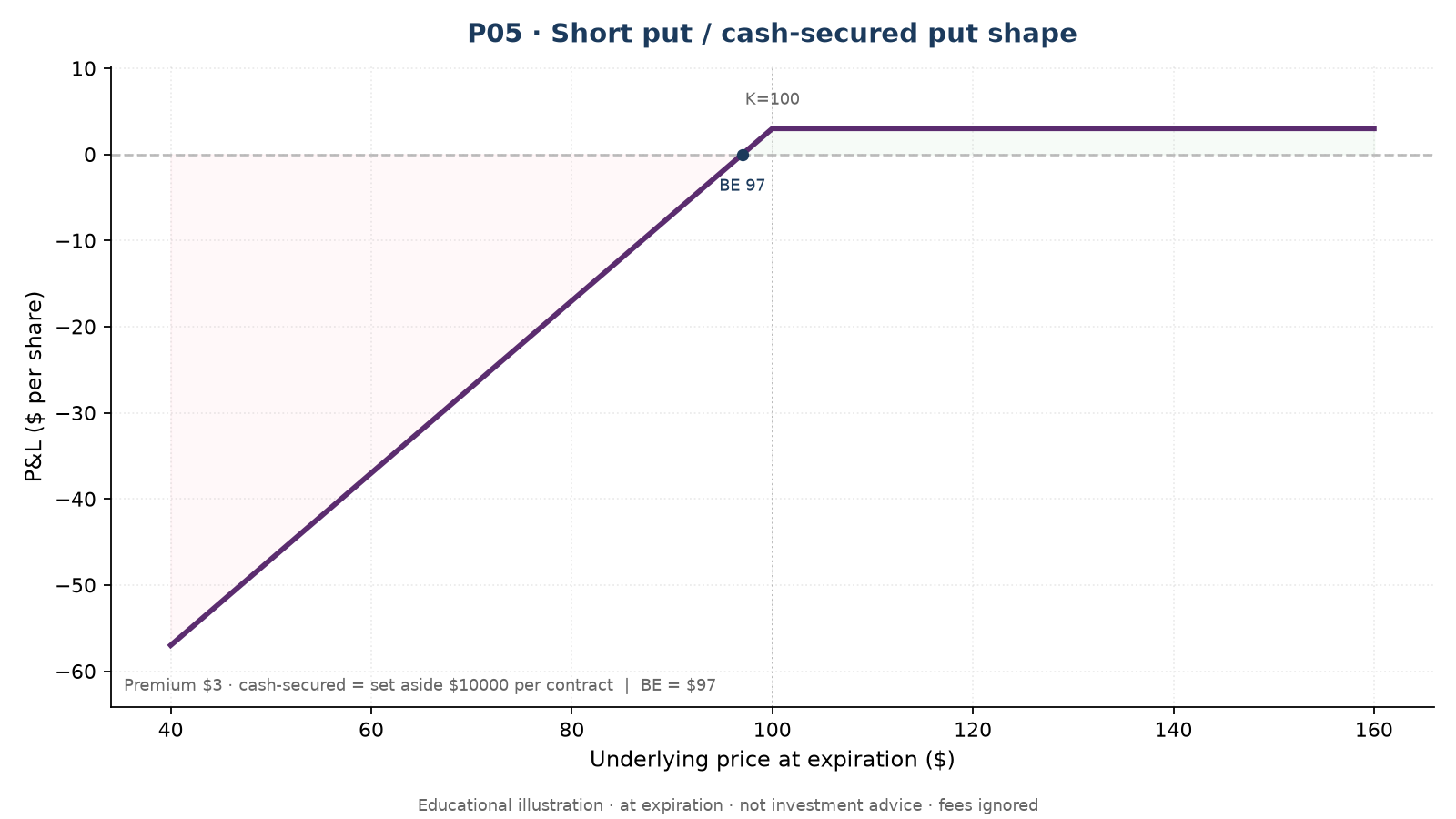
Cash-secured means you actually set aside the cash to buy the shares if assigned (about $10,000 for a $100 strike, one contract). Same payoff shape as a "naked" short put in the chart. Different sleep and different broker rules. In this course, short puts are not "free income." They are willing buyer tools: you only sell the put if you are happy to own the stock at that effective price.
Intrinsic vs extrinsic (the two layers of premium)
Premium is not one blob. Split it:
- Intrinsic value = what the option would be worth if expiration were right now (calls: max(S−K, 0); puts: max(K−S, 0)).
- Extrinsic value (time value) = everything else you're paying (or collecting) for uncertainty and time.
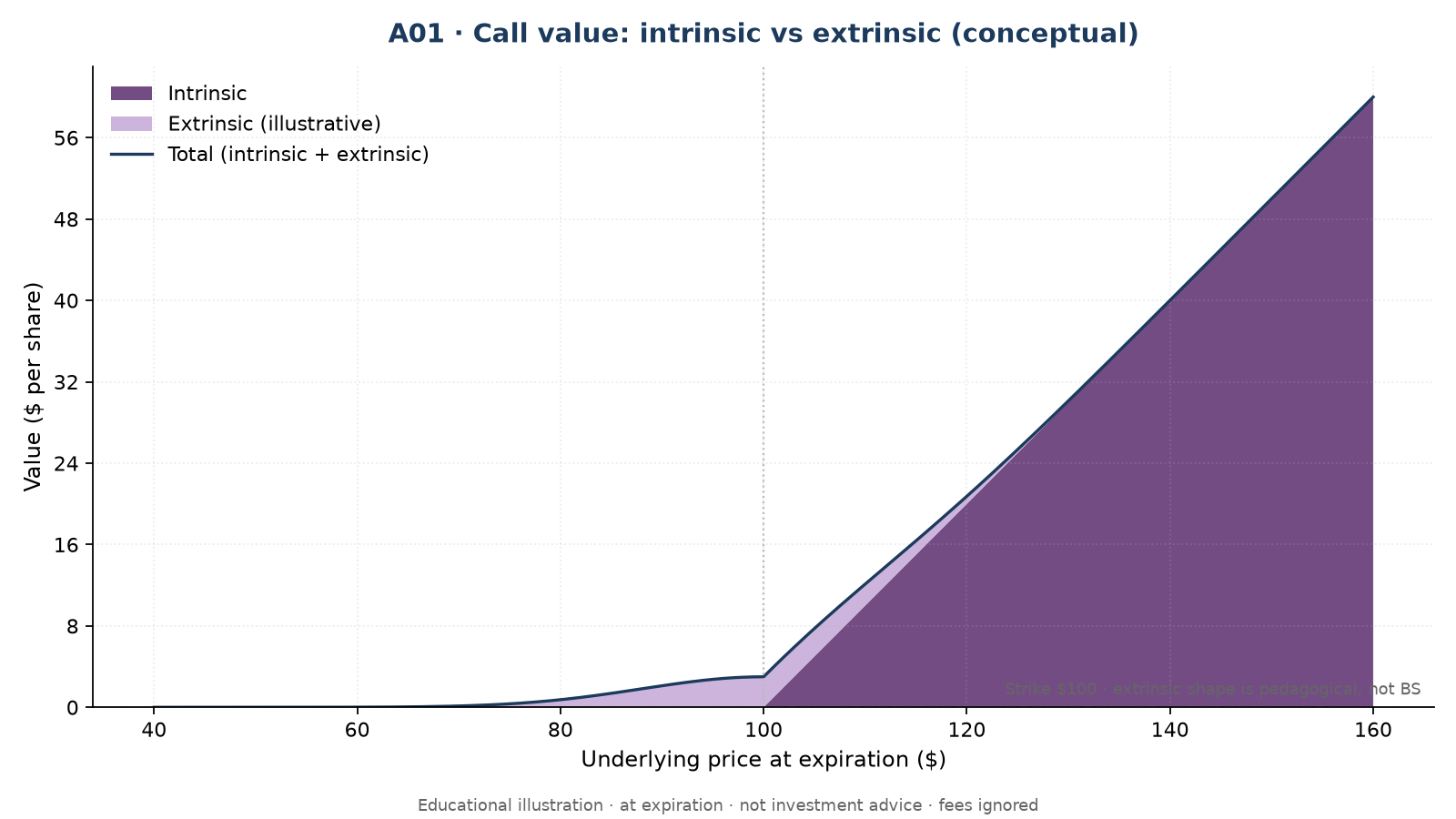
Deep in-the-money options are mostly intrinsic. Out-of-the-money options are all extrinsic (and can go to zero). At-the-money options are where time value is usually fattest. Sellers of premium are often selling extrinsic. Buyers hoping for a miracle are often buying extrinsic with a short clock.
Moneyness: ITM, ATM, OTM
| Term | Call | Put |
|---|---|---|
| In the money (ITM) | Stock above strike | Stock below strike |
| At the money (ATM) | Stock near strike | Stock near strike |
| Out of the money (OTM) | Stock below strike | Stock above strike |
Moneyness is not a moral grade. It is a location on the chart. Far OTM calls are cheap for a reason. Far OTM puts used as lottery crash tickets are a different product from far OTM covered-call strikes used as a happy-sell price. Same letters on the chain. Different jobs.
Bid, ask, and the chain (liquidity is a risk)
On a broker Options Chain (Schwab Trade Builder is one place you'll live), each strike shows:
- Bid — what buyers are bidding (what you might hit if you sell)
- Ask — what sellers are offering (what you might pay if you buy)
- Volume and open interest (how alive the line is)
The gap between bid and ask is a friction tax. On illiquid LEAPs, that tax can be large enough to erase a clever thesis. Operators prefer liquid names and mid-ish limits over market orders into a canyon.
Under Trade Builder you will also see two sibling tabs you will master in Weeks 3 and 4:
| Tab | Job |
|---|---|
| Options Chain | Live market, build tickets (this week) |
| Pricer | What-if machine (change IV, price, days) — Week 3 |
| Greeks | Live delta/gamma/theta/vega dashboard — Week 4 |
If you can open a paper or supervised account, click those tabs this week just to orient. You do not need to trade.
Assignment and exercise (the delivery side)
- Exercise — the long option holder uses the right.
- Assignment — the short option holder is chosen to fulfill the obligation.
For a short call that finishes in the money, assignment means you sell 100 shares at the strike (you need to own them if you're covered, or you invent a short stock mess if you're not). For a short put that finishes in the money, assignment means you buy 100 shares at the strike.
American options can be exercised early (dividends on calls are a classic reason). Most retail shorts are managed around expiration, but "I'll just roll forever" is not a plan. It's a story. We return to that in Week 7.
Capital at risk (the operator's first filter)
Before any cleverness:
| Side | Rough capital / risk picture |
|---|---|
| Long call or long put | You can lose what you paid (premium × 100 × contracts) |
| Short put (cash-secured) | You must be ready to buy stock: strike × 100 per contract (reduced economically by premium) |
| Short call covered | Shares you already own can be called away; downside is still mostly the stock |
| Short call naked | Undefined upside risk — forbidden as "income" in this course |
If you cannot state max loss in a sentence, you do not understand the contract yet.
See Through It: "It's only $2"
A $2.00 premium looks like lunch money. One contract is $200. Ten contracts is $2,000. A short put at a $400 strike is $40,000 of cash set-aside per contract, not "a $4 option."
Casinos price chips to feel small. Broker chains quote per share for history and convention. You convert to dollars before you feel anything.
Biblical thread: promises with a price
Proverbs is hard on people who co-sign casually (surety). A short option is a modern cousin of a contingent promise: you are on the hook if a condition hits. Getting paid a premium does not make the promise free. It prices it.
"The prudent sees danger and hides himself, but the simple go on and suffer for it" (Proverbs 22:3 ESV).
Prudence here is not fear of markets. It is reading the contract before you sign it with your click.
Lab teaser
Lab #2: Contract Decoder — Take six chain-style rows (live Schwab Options Chain or the provided table). For each, label type, moneyness, intrinsic, extrinsic estimate, and capital at risk if long vs if short.
Takeaways
- Options are standardized rights (long) and obligations (short) with a cash price called premium.
- Multiplier 100 turns per-share quotes into real money.
- Payoff charts at expiration show the shape of the promise; learn the hockey sticks cold.
- Intrinsic vs extrinsic splits what is "already real" from what is time and uncertainty.
- Bid/ask and liquidity are part of the risk.
- Short puts and covered calls only make sense as stock decisions with cash or shares behind them.
Next week: pricing intuition and the Schwab Pricer tab — what happens when you change volatility, time, and the stock price on purpose.
Homework
Chapter 2 Homework — Anatomy of a Contract
Course: Options for Operators Points: 20 Educational only. Use toy numbers unless a table is provided.
A. Definitions (6 pts)
- (2) In one sentence each, define call and put from the buyer's point of view.
- (2) A call is quoted at $4.20. What is the approximate cash debit for 1 contract (ignore fees)? For 3 contracts?
- (2) Explain ITM / ATM / OTM for a put when the stock is at $50 and strikes are $45, $50, and $55.
B. Chart reading (6 pts)
Use the long call chart idea (strike $100, premium $3) from the reading.
- (2) What is the max loss per share? At what stock prices do you realize it at expiration?
- (2) What is the breakeven stock price at expiration?
- (2) At expiration, stock is $108. What is P&L per share on that long call?
C. Capital at risk (4 pts)
- (2) You sell 1 cash-secured put, strike $80, premium $2.00. Roughly how much cash should be set aside to secure assignment? What is your approximate effective purchase price if assigned?
- (2) Why is a naked short call treated as an anti-pattern for "income" in this course? (2–3 sentences)
D. Desk & friction (2 pts)
- (1) Name the three Schwab Trade Builder tabs introduced this week and give a one-phrase job for each.
- (1) Why can a wide bid/ask on a LEAP matter as much as your thesis?
E. Reflection (2 pts)
- (2) Pick one contract you might be tempted to buy as a "lottery ticket." Without numbers, what would have to be true for it to be an operator decision instead of entertainment?
Lab
Lab #2 — Contract Decoder
Week 2 · Anatomy of a Contract Time: 35–45 minutes Tools: Spreadsheet + Schwab Options Chain (optional) or frozen table below
Goal
Decode option rows until the five knobs and capital-at-risk are automatic.
Setup
Create a sheet with columns:
ticker | type | side | strike | expiry | bid | ask | mid | stock | moneyness | intrinsic | extrinsic_est | long_max_loss_$ | short_capital_note
Mid ≈ (bid+ask)/2. Intrinsic (call) = max(stock − strike, 0). Intrinsic (put) = max(strike − stock, 0). Extrinsic_est ≈ max(mid − intrinsic, 0). Long max loss $ ≈ mid × 100 × contracts (use 1 contract).
Frozen practice rows (if no live chain)
Assume stock $100.00 today.
| type | strike | bid | ask |
|---|---|---|---|
| call | 100 | 2.90 | 3.10 |
| call | 110 | 1.40 | 1.55 |
| call | 90 | 10.80 | 11.20 |
| put | 100 | 2.85 | 3.05 |
| put | 90 | 1.35 | 1.50 |
| put | 110 | 10.60 | 11.00 |
Tasks
- Fill the decoder columns for all six rows (side = long for the first pass).
- For the $100 put, add a second row as short cash-secured: write collateral ≈ $10,000 and effective entry if assigned.
- Star any row where bid/ask width is > 10% of mid (friction flag).
- Write three sentences: which row looks like a lottery, which looks like insurance, which could be a process short (only if willing).
Deliverable
Export or screenshot the sheet + the three sentences. Keep the template for later weeks.
Stretch (optional live)
Open Schwab → symbol → Trade Builder → Options Chain. Replace the frozen table with six live rows on a liquid name. Do not place orders.