Options for Operators
Premium is rent. Marks are weather. Process is the grade.
Educational only. Not investment advice. Fictional names. No live broker and no real account.
Syllabus · Open week 1 on the desk · Lab · Next
Chapter 1: Options Are Not a Side Hustle
Options for Operators · Week 1 Big idea: Options express stock decisions you already hold. Betting is the failure mode.
Educational only. Not personalized investment advice. Process examples are patterns, not recommendations.
If you finished Advanced Finance, you already know the machine.
Banks don't exist to be your friend. Wirehouses sold stories for commissions. Derivatives can be scalpels or weapons. Crises rhyme: innovation, leverage, overconfidence, collapse, new rules, amnesia.
That course taught you to see. This course teaches you a smaller, sharper skill: how to use option contracts as tools inside a portfolio you already understand — without turning your account into a casino floor with better charts.
Where you are in the stack
| Course | You learned to… |
|---|---|
| Riches Redeemed | Be a careful consumer of money |
| Advanced Finance | See the machine (institutions, instruments, crises, bias) |
| Options for Operators | Use options as an operator toolkit — allocation, entry, harvest, insurance |
You are not starting from zero. You already met calls and puts in the Alternatives week. You already saw Black-Scholes and LTCM in the hedge fund story. We will not re-teach "what is a stock." We will re-teach what options are for.
Two jobs only
Options are good at roughly two honest jobs:
- Allocation — Get paid to wait to buy what you want cheaper, or to stand ready to sell what you're willing to trim higher.
- Risk transfer — Pay (or finance) a floor under shares you own; or define risk when you express a view.
They are bad at:
- Replacing a life
- Guaranteeing income
- Turning ignorance into edge
- Making marks (daily P&L on the option) more important than the stock decision
Canonical line for this whole course:
Premium is rent for standing ready to buy what you want cheaper and sell what you're willing to trim higher. Marks are weather.
The shape that tempts everyone
Here is a long call at expiration (toy world: strike $100, premium $3). Limited loss. Open upside. Beautiful asymmetry.
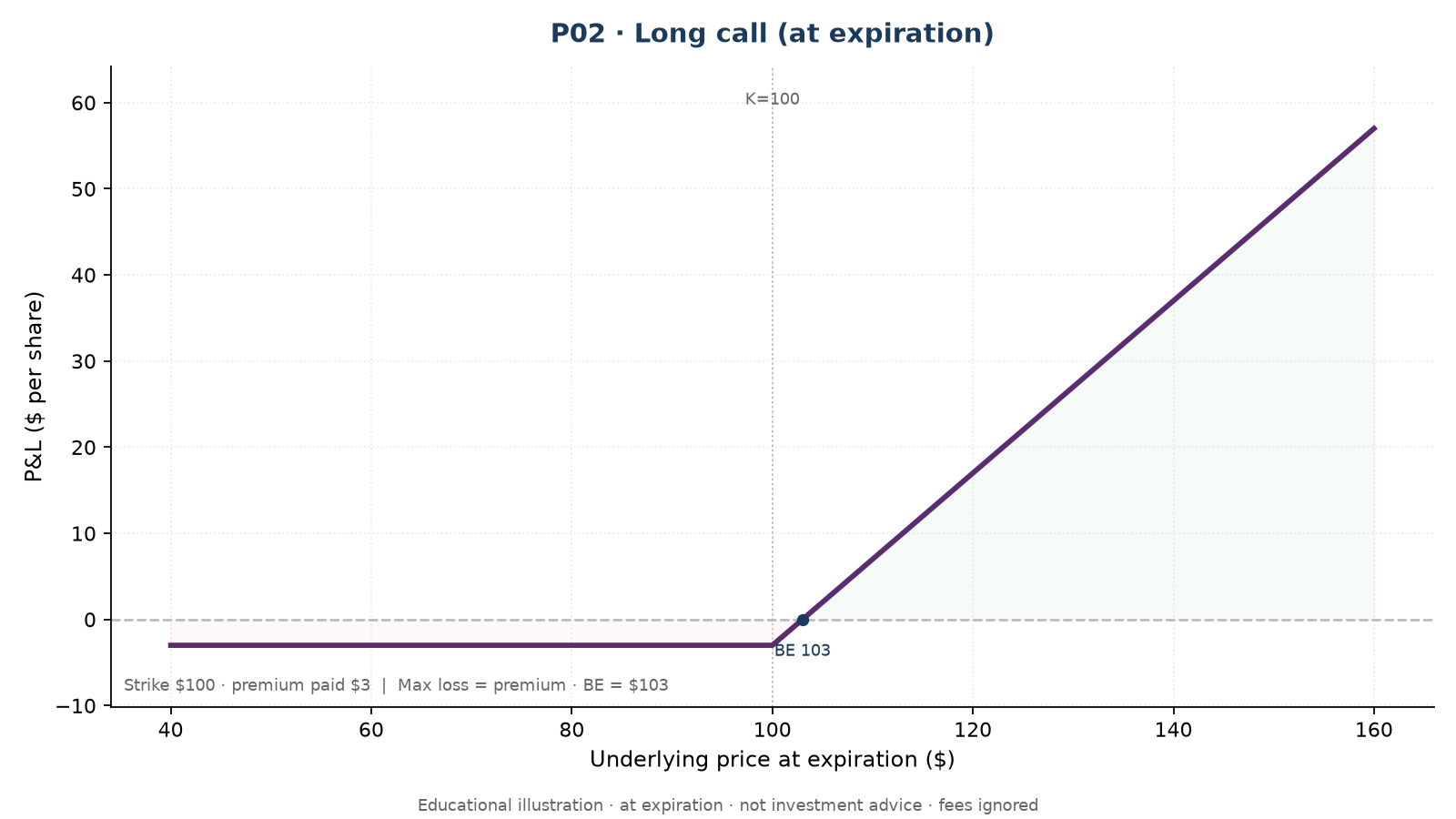
This shape is why marketing loves calls. "Defined risk! Explosive upside!" All true as geometry. All incomplete as wisdom. Without a thesis, a fuse, and a size that cannot break you, this is a lottery ticket with a professional vocabulary.
We will teach the shape cold (Week 2). We will not worship it.
The shapes operators actually live in
Later weeks go deep. For day one, imprint two process shapes.
Willing seller: covered call
You own stock. You sell a call at a price you'd be happy to sell shares. You collect premium. You cap some upside on those shares.
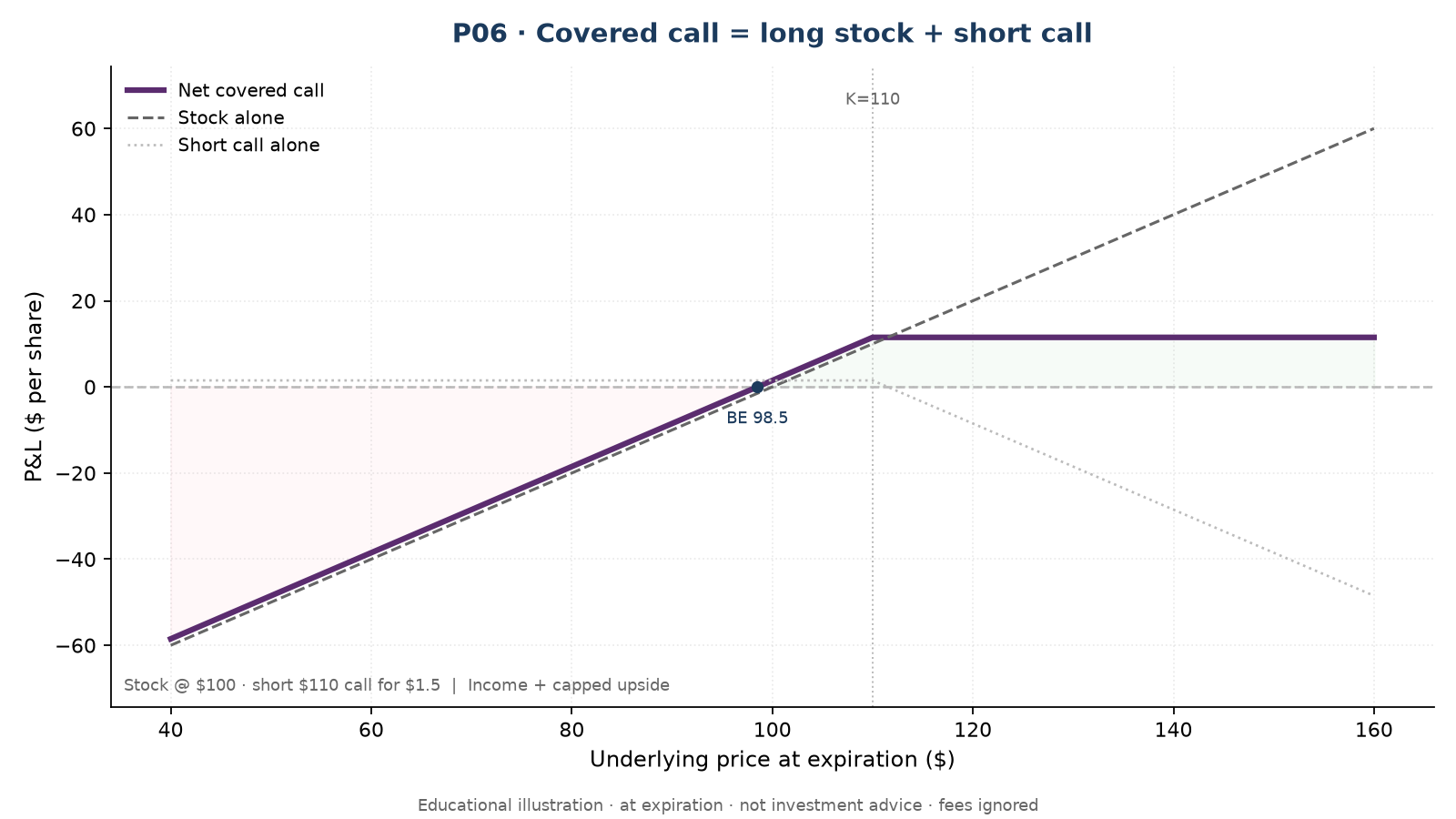
Income is real. So is the cap. If you would cry when the stock is called away, you sold the wrong strike.
Willing buyer: cash-secured put
You want stock (or more of it) at a lower price. You sell a put at that process price and set cash aside. You collect premium while you wait. If assigned, you buy shares you already wanted.
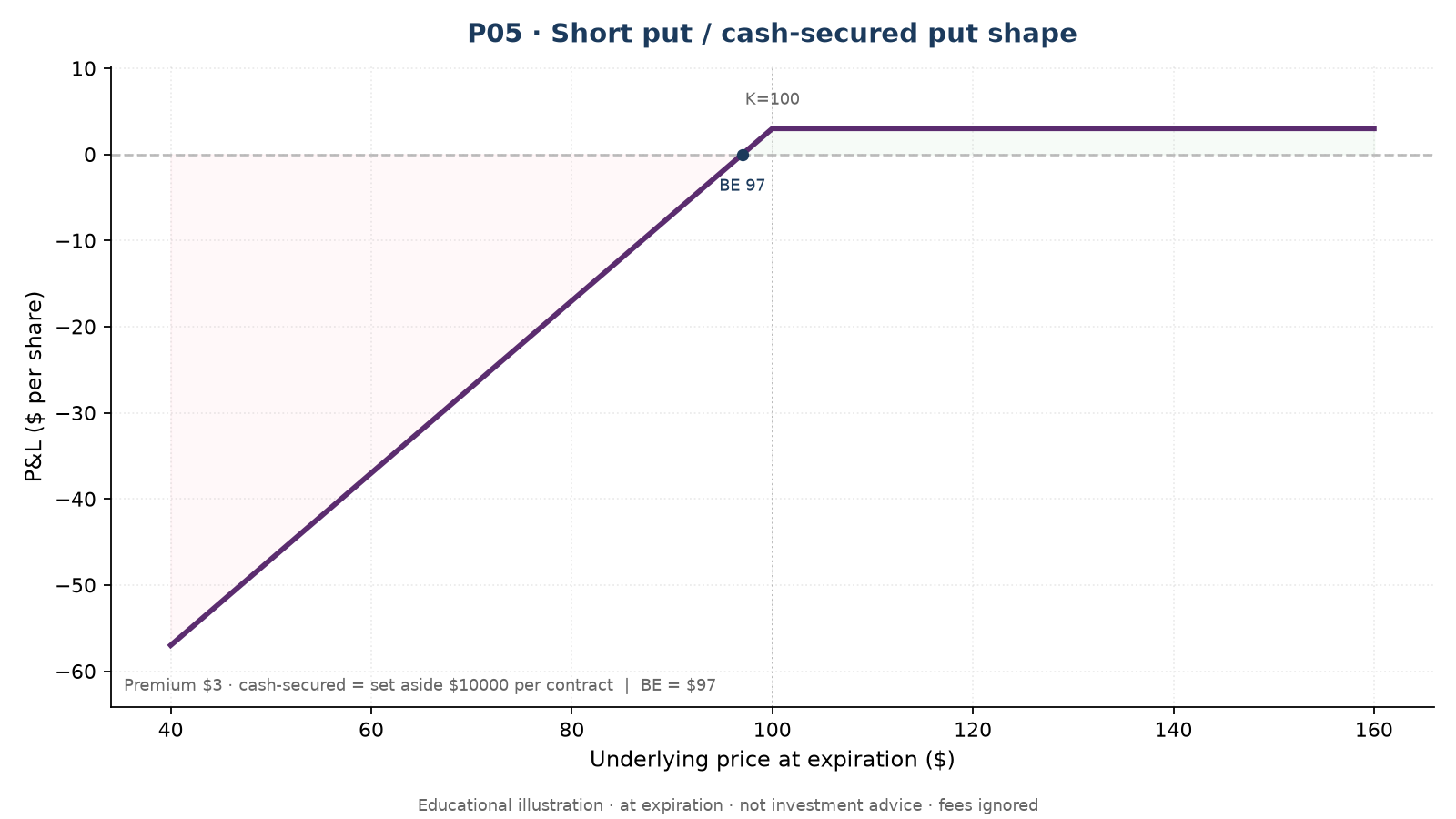
If you would hate owning the shares at that strike, you sold entertainment, not an entry order.
Together, these are willing both sides. Not a personality cult. A discipline: every short option maps to a stock verb — buy or sell — that you already accept.
A short history (so you don't think this is TikTok-native)
- Companies and traders have used option-like contracts for centuries (think early warrants and privilege contracts).
- CBOE listed standardized equity options in 1973, the same era the Black-Scholes framework spread through desks.
- Standardization + clearing made options a mass product.
- Zero-commission retail and mobile apps then made them a habit product.
Tools got cheaper. Judgment did not get automated. If anything, the friction that used to slow you down disappeared.
Edward Thorp used math to find edge and control risk (casinos, then markets). Warren Buffett warned that derivatives can be weapons of mass destruction — and still used contracts when they served Berkshire. Both can be true. The instrument is not the morality. The sizing and purpose are.
Doctrine card (pin this)
| Rule | Meaning |
|---|---|
| Stock decision first | No option without a happy-buy or happy-sell price |
| Unit = 100 shares | One contract is a lot of obligation |
| Partial cover | Never call away your entire conviction core without a plan |
| Cash-secured means cash | Short puts need real collateral |
| Marks are weather | Red marks on still-valid OTM shorts are not automatic exits |
| No naked call "income" | Undefined upside risk is not a side hustle |
| Write it down | DecisionLog before order (habit built in Module 3) |
See Through It: "High probability income"
You'll hear win-rate theater: "80% of these trades win!"
Short options often expire worthless for the seller. That can look like a high win rate while one loss wipes many small wins. Probability of a small win is not the same as edge, and neither is the same as stewardship.
Ask:
- What is the max loss?
- What stock decision does this express?
- What happens if I'm wrong for three months, not three days?
- Am I managing the option mark or the business I own?
If the ad cannot answer those, it is not operator content. It is content.
Biblical thread: wise as serpents
"Behold, I am sending you out as sheep in the midst of wolves, so be wise as serpents and innocent as doves" (Matthew 10:16 ESV).
Wisdom here is literacy: read the promise, price the obligation, refuse theater. Innocence is refusing to become the wolf — no selling traps to others, no dressing gambling as vocation.
Premium is not manna. It is a price on a contingent promise. Treat it that way.
How this course will feel
| Module | Weeks | You will… |
|---|---|---|
| 1 Machine → Contract | 1–3 | Doctrine, anatomy, pricing, Pricer tab |
| 2 Deep literacy | 4–8 | Greeks, vol, strategy map, assignment, pantheon |
| 3 Practical use | 9–12 | Overlay, harvest/CSP playbooks, insurance, graveyard, your OS |
You will leave with a written Options Operating System, not a head full of tickers.
Labs use spreadsheets you keep. Charts in this course are code-accurate payoff diagrams (not freehand guesswork). Schwab's Greeks and Pricer tabs show up as real desk literacy, with a no-account fallback.
Lab teaser
Lab #1: Decision Gate — For three fictional holdings, write happy-buy and happy-sell prices before any option is allowed. If you cannot name those prices, you are not allowed to open the chain yet.
Takeaways
- Options are tools for allocation and risk transfer — not a side hustle identity.
- Premium is rent for a stock decision; marks are weather.
- Asymmetry (long call) can be wisdom or lottery; process decides.
- Covered calls and cash-secured puts are the operator's default verbs: willing sell / willing buy.
- High win-rate marketing is not a risk education.
- This course ends in a personal OS, not a trade feed.
Next week: anatomy — five knobs, payoff charts, and the chain.
Homework
Chapter 1 Homework — Options Are Not a Side Hustle
20 points · Educational only
- (3) Place this course in the AJES stack: one sentence each for Riches Redeemed, Advanced Finance, and Options for Operators.
- (2) State the course's two honest jobs for options.
- (3) In your own words, explain "premium is rent" and "marks are weather."
- (3) Why can a long call's beautiful asymmetry still be a bad decision?
- (3) Define willing seller and willing buyer with the matching option tool named in this chapter.
- (2) Spot the trap: rewrite this ad line so an operator would reject it, then rewrite it so an operator might accept the structure (not a tip): "Sell puts on anything for 80% win-rate income!"
- (2) Name two historical checkpoints from the short history section and why standardization mattered.
- (2) Reflection: What would "options as a side hustle" look like in your life this year — and what boundary will you set before Module 3?
Lab
Lab #1 — Decision Gate
Week 1 · Options Are Not a Side Hustle Time: 30–40 minutes Tools: Spreadsheet
Goal
Prove you can name happy-buy and happy-sell prices before any option chain is allowed.
Setup
Three fictional holdings (or your own watchlist names if you prefer — still educational, not advice):
| Name | Shares | Cost basis (toy) | Thesis in 8 words |
|---|---|---|---|
| A | 200 | $40 | Quality compounder; overweight risk if +30% |
| B | 100 | $120 | Cyclical; happy to rebuy lower |
| C | 0 | — | Want starter position on weakness only |
Tasks
- For A and B: write happy-sell (process trim price) and core-keep shares you would not call away.
- For B and C: write happy-buy (process entry) and max cash you'd secure for one CSP (100 shares).
- Explicit non-arms: one sentence each — a call you would not sell and a put you would not sell (and why).
- Doctrine check: copy the course line on premium/rent and marks/weather into the sheet header.
Rule
If happy-buy or happy-sell is blank, the option column stays locked for that name.
Deliverable
One sheet with the table filled. Bring it back in Week 9 when you build Overlay Policy v1.