Options for Operators
Premium is rent. Marks are weather. Process is the grade.
Educational only. Not investment advice. Fictional names. No live broker and no real account.
Syllabus · Open week 10 on the desk · Lab · Previous · Next
Chapter 10: Covered Call Harvest + CSP Entry (Playbooks)
Options for Operators · Chapter 10 Big idea: Repeatable processes beat clever one-offs.
Educational only. Public-ticker patterns are process illustrations, not recommendations or live tips.
You have the doctrine. Now the operating manuals.
Feature A — Further-OTM "happy sell" covered call
When a name is overweight (or will be after a run) and you have a clear thrilled-to-sell price:
- Strike often ~20–35% OTM when the job is soft-cap / harvest (not near-term panic trim).
- Prefer ~30–60 DTE when credit clears a minimum gate after spread/fees.
- Partial cover only; core-keep floor locked first.
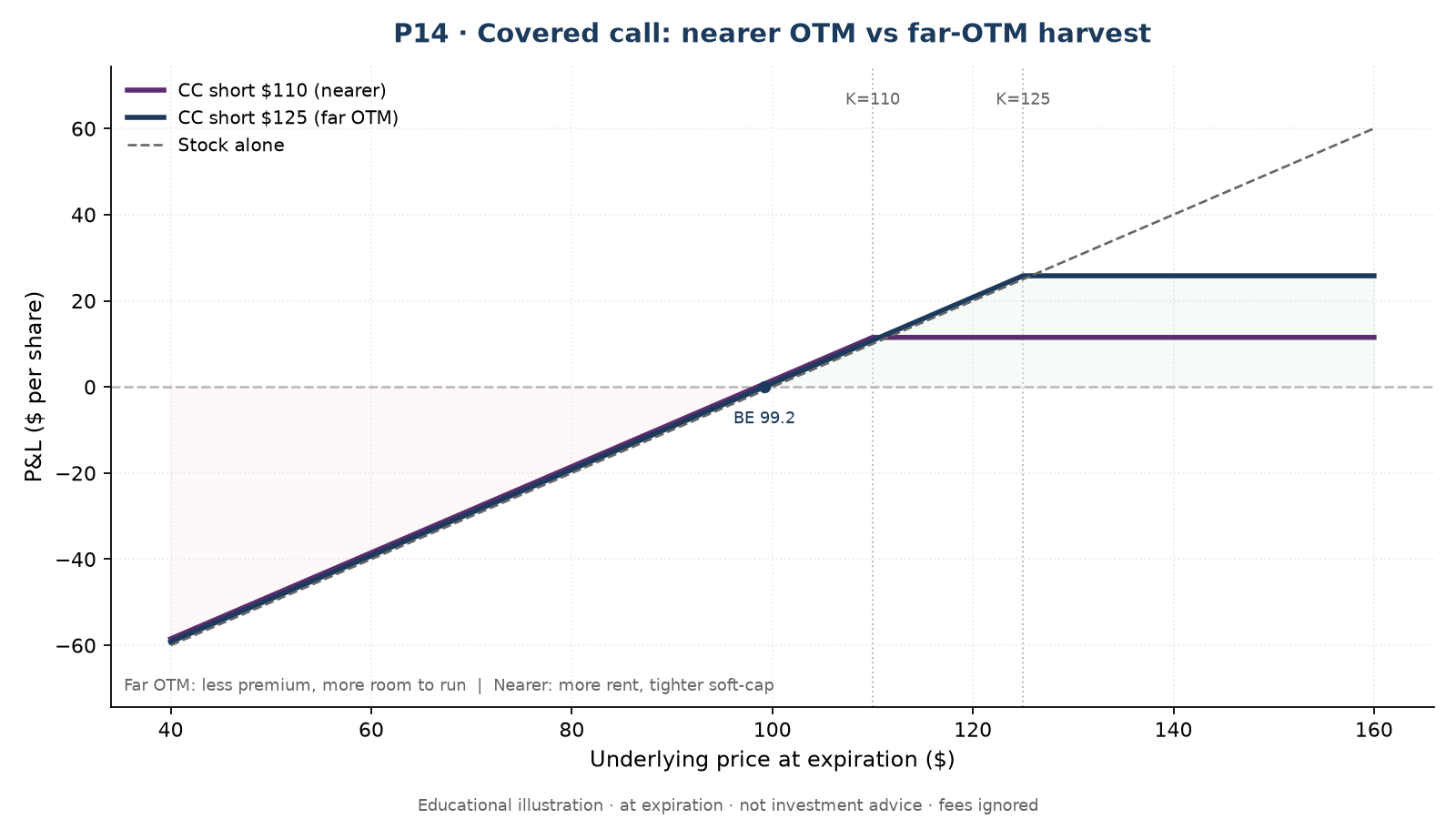
Nearer OTM: more rent, tighter cap. Far OTM: less rent, more room for the compounder to run. Choose by job, not by max premium greed.
LEAP path (when near-term far-OTM is dead)
On low-IV names, near-term far-OTM calls can pay noise ($1–$30 total). A longer-dated call at the same happy-sell strike may pay material credit. You are selling time at the process price. Only if you are willing to be called across that whole window. Use mid-ish limits; wide LEAP markets are a tax.
Feature B — GTC buy-to-close for a fraction of max credit
After short premium fills, place a buy-to-close that banks a slice of the win early.
| Leg type | Example take-profit of max credit | BTC limit ≈ |
|---|---|---|
| Far-OTM harvest | ~30% | 0.70 × credit |
| Standard / fatter premium | 50% early / 70% strong | 0.50× / 0.30× credit |
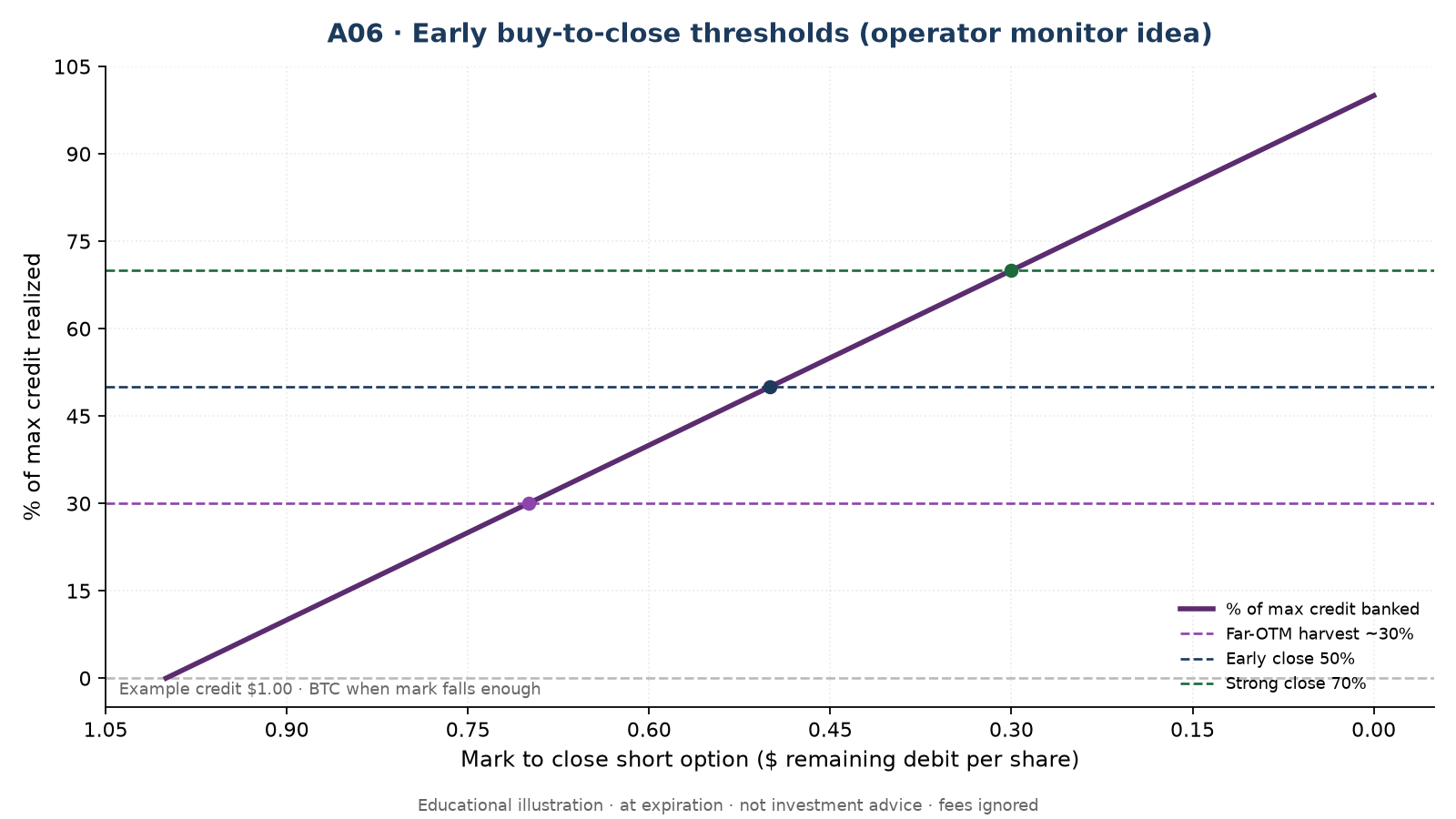
If the mark is red but still OTM and thesis intact: hold. Do not panic-BTC for weather.
CSP entry playbook
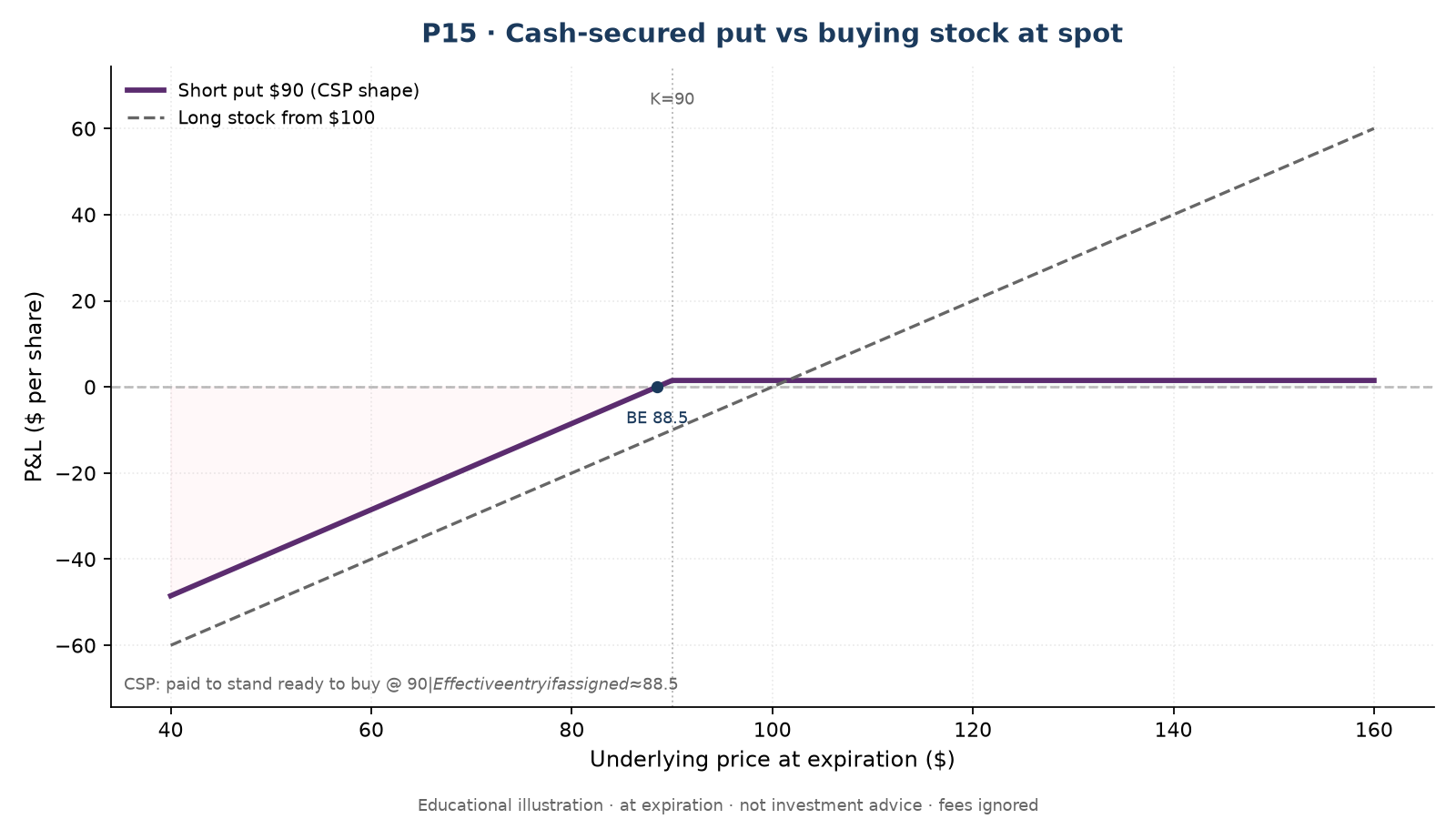
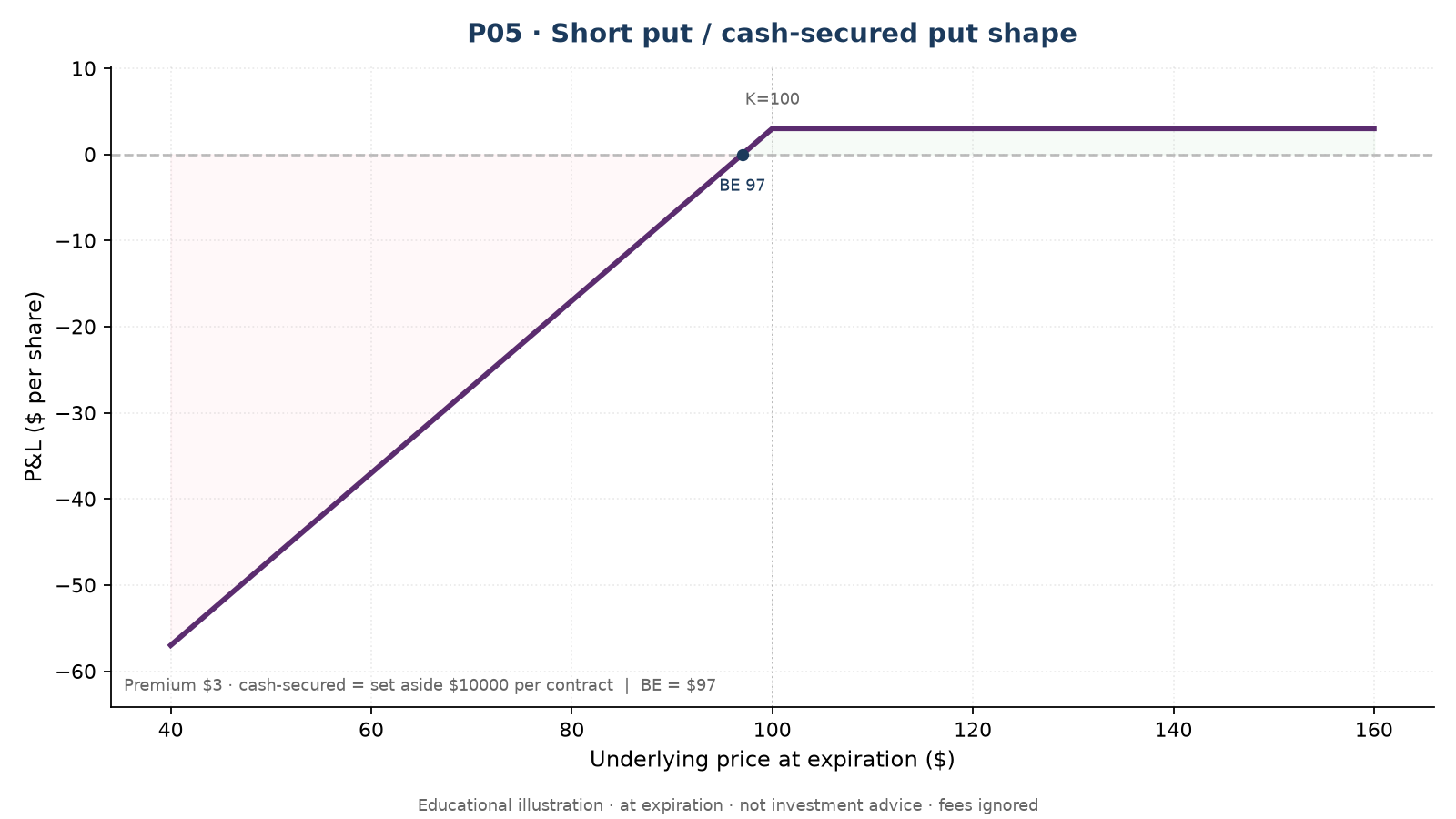
- Re-underwrite: "I want 100 shares at this strike."
- Collateral = strike × 100 (per contract).
- Check cash floor / collateral caps.
- Credit must clear friction.
- On fill: optional GTC BTC per policy.
- If assigned: you bought what you wanted — success of plan, not "got dumped."
Operating loop
1. Name has happy-buy or happy-sell + rails OK
2. Size contracts (100-share lots only)
3. Sell CC or CSP at process strike / liquid DTE
4. On fill: GTC BTC if policy says so
5. Outcomes: BTC / expire OTM / assign / roll only with new log
6. Within 24h of change: update book truth (positions import habit)
Educational case patterns (public tickers, process only)
Case A — Energy-style nearer OTM covered call (DVN-pattern)
Soft-trim / harvest on a holding with a process upside strike (example narrative: short call below a "happy enough to sell a lot" price, still above spot). Core-keep floor on remaining shares. Early close when ~50%+ of credit banked if not ripping into strike.
Case B — Low-IV LEAP harvest (BMY-pattern)
Happy-sell strike clear; near-term far-OTM credit is tip money; sell longer-dated call at process strike for material mid credit; GTC BTC ~30% of max; hold through red marks while still OTM if thesis intact.
Case C — CSP early close (MSFT-pattern)
Willing buyer at process put strike; collect fat credit; stock strengthens; bank large fraction of max credit via BTC; no assignment; still own any residual shares you already had. Re-arm only with a new log — not automatic.
Explicit non-arm texture
Some names stay equity ladder only (no CSP) until size, float, or thesis gates clear. Non-arm is a skill (SPCX-style deferral pattern).
Case study — Berkshire Hathaway sells puts (public record)
Educational only. Not investment advice. Everything below comes from Berkshire's own letters, its SEC filings, and Buffett's own words at the annual meeting. It is a process illustration, not a trade to copy.
Warren Buffett, who built Berkshire Hathaway and ran it for six decades, is the world's best-known buy-and-hold investor. He has also, a few times, sold puts on things he wanted to own. Look at what he did, and at what he says about it afterward.
Berkshire 1 — Coca-Cola puts (1993): paid to wait
The story. In 1993 Berkshire sold puts on about 5 million Coca-Cola shares, struck around $35, for a premium of about $7.5 million. Coke did not fall to the strike. No shares were put to Berkshire, and it kept the premium. "In that particular case, we made 7 1/2 million dollars."
The next spring a shareholder asked whether he would keep doing it. His answer:
"If we like something well enough to write a put on it, we're probably better off buying the security itself."
He gave two more reasons it was not worth repeating. Position limits at the brokers meant he would have had to spread the puts across several of them, and "I don't think it's as useful a way to spend my time as just looking for securities to buy outright."
A second account comes from Andrew Kilpatrick, author of the Buffett biography Of Permanent Value. A 2019 Nasdaq article that summarizes his book says the puts were sold in April 1993, with Coke around $39, for $1.50 a share. Buffett himself remembered it as "sometime in the early fall or thereby — I don't remember exactly." Treat the month as uncertain. The size, strike, and premium agree.
The lesson. The put was a willing-buyer ticket. The strike was a price he would gladly pay, and he had the cash to pay it. The premium was a side effect. Notice what he concluded. He said that if he liked a company enough to write a put on it, he was probably better off buying the stock itself, partly because the puts could never be large enough to matter to Berkshire. There is one more cost to see. A put pays you to wait, but if the stock rises, you end up owning none of a business you wanted.
Berkshire 2 — Burlington Northern Santa Fe puts (2008): assigned, on purpose
The story. In October 2008, Berkshire's insurer National Indemnity (NICO) sold 3,261,111 puts on Burlington Northern Santa Fe, the railroad company (ticker BNI), at $77 and $80, collecting $5.78–$7.03 per share. That came to almost $22 million. BNI traded around $80 at the time.
In December the stock fell, and the puts were exercised. Berkshire's Schedule 13D lists the shares it was forced to buy:
| Date (2008) | Shares | Price | How |
|---|---|---|---|
| Dec 8 | 1,309,524 | $80.00 | Exercise of put written by NICO |
| Dec 9 | 761,111 | $77.00 | Exercise of put written by NICO |
| Dec 9 | 1,190,476 | $80.00 | Exercise of put written by NICO |
| Dec 11 | 1,217,500 | $75.00 | Exercise of put written by NICO |
| Dec 11 | 1,000,000 | $76.00 | Exercise of put written by NICO |
The two Dec 11 rows came from other puts that NICO had written. The filing does not say when those puts were sold or what premium they paid.
On the Dec 8–9 assignments, Berkshire paid $258.6 million. That was $7.1–$16.3 million more than the same shares cost in the market those days. It had already banked about $22 million of premium. The filing also shows one more open put, written Dec 3, 2008, that could make Berkshire buy 2,325,000 more shares from Citibank at $75.
After the December buys, Berkshire owned 20.47% of the railroad. A year later it agreed to buy the rest, and Burlington Northern Santa Fe (BNSF) became a Berkshire company in early 2010.
The lesson. This is Chapter 10's CSP playbook at full size. The plan was to own BNI shares at about $75–$80, and assignment was the plan working. It was not a case of getting "dumped" on. Assigned shares that sit below the strike for a while are weather. The climate was a railroad he wanted to own outright.
Berkshire 3 — The index puts (2004–2008): a different job entirely
The story. By the end of 2008, Berkshire had sold long-dated puts on four stock indexes: the S&P 500, FTSE 100, Euro Stoxx 50, and Nikkei 225. Their notional value was $37.1 billion. Berkshire collected $4.9 billion in premium up front and invested it. The contracts were European-style: "Neither party can elect to settle early; it's only the price on the final day that counts." When Buffett wrote his 2008 letter, the first contract was due on September 9, 2019 and the last on January 24, 2028. Later filings give different dates. Berkshire's 10-K for 2016 says the contracts expire between June 2018 and January 2026.
At year-end 2008, the accounting model put the liability at $10 billion. That meant a reported $5.1 billion mark-to-market loss, even though nothing was owed for at least another decade. Buffett explained that to lose the full $37.1 billion, "all stocks in all four indices would have to go to zero."
Later filings show the book wound down. Berkshire's 2022 annual report: "Substantially all of our contracts have expired and our exposure to loss in the future is insignificant."
The lesson. Do not copy this one. It was not a willing-buyer ticket on a business. It was insurance underwriting, selling crash protection for 15 to 20 years so Berkshire could invest the premium, at a size only a balance sheet like Berkshire's can carry. It does teach one thing you can use: a $5.1 billion paper loss was just a mark. It could not force Berkshire to sell anything, because nobody could make Berkshire settle early. Most of the contracts also did not require Berkshire to post collateral, so a bigger paper loss did not pull cash out of its accounts. Only a few contracts had collateral terms. If a mark can force you out, it is not weather any more. It is a margin call.
Where Berkshire is today
Berkshire's Q2 2026 quarterly report (June 30, 2026) does not report any written options. Its 2025 annual report says, discussing interest-rate risk, "We generally do not utilize derivative products, such as interest rate swaps, to manage interest rate risks." The only derivatives the report discusses are fuel and commodity contracts at Pilot, Berkshire's chain of truck stops.
What it does have is cash. Cash plus Treasury bills came to about $365.5 billion, roughly 29% of total assets. That is the fat-pitch reserve from Chapter 9, at Berkshire scale.
And you won't find covered calls anywhere in this record. Our read is that Buffett does not want to cap the upside on businesses he means to own forever. In this course's language, core-keep is 100%.
What an operator takes from Berkshire
- Sell puts only at strikes you would be glad to own. Coke at $35 and BNI at $75–$80 were prices Buffett was already happy to pay.
- Keep every put fully cash-secured. Have the strike × 100 in cash for every contract before you sell. Berkshire could pay for every assigned share without selling anything else.
- Never let anyone force you to sell. A mark cannot hurt you if nothing can make you close. If a margin call, a collateral cap, or a cash floor could force your hand, size down until it can't.
- If you love it, consider just buying it. The put is a tool, not a virtue. Buffett's own verdict was that the outright buy was usually better.
- Size is a job description. A $37.1 billion index-put book is a different sport. Copy the job, not the cosplay (Chapter 8).
Check yourself
- Buffett's Coke puts expired worthless and he kept $7.5 million. Why did he still say he was "probably better off buying the security itself"?
- Berkshire paid up to $16.3 million more than market for BNI shares in December 2008. Was the assignment a loss? Use the premium, the plan, and what happened next in your answer.
- The index puts showed a $5.1 billion loss on paper with nothing owed for a decade. Which two contract features let Berkshire treat that mark as weather? Why would the same mark on your account be a different story?
Sources
- Buffett, 1994 Berkshire Hathaway annual meeting, afternoon session, segment 8 ("Unlikely to write put options on Coca-Cola again"): https://buffett.cnbc.com/video/1994/04/25/afternoon-session---1994-berkshire-hathaway-annual-meeting.html
- Kilpatrick, Of Permanent Value, ch. 34, as summarized in Nasdaq (2019): https://www.nasdaq.com/articles/the-win-win-strategy-buffett-used-to-make-$7.5-million-instantly-2019-08-30
- Berkshire Hathaway, Schedule 13D on BNI (event date Dec 11, 2008): https://www.sec.gov/Archives/edgar/data/934612/000119312508253642/dsc13d.htm
- CNBC, Dec 10, 2008: https://www.cnbc.com/2008/12/10/warren-buffetts-burlington-northern-stake-rises-to-almost-20-after-optionsrelated-stock-buy.html
- Berkshire Hathaway 2008 shareholder letter: https://www.berkshirehathaway.com/letters/2008ltr.pdf
- Berkshire Hathaway 2009 shareholder letter (BNSF acquisition): https://www.berkshirehathaway.com/letters/2009ltr.pdf
- Berkshire Hathaway Form 10-Q, quarter ended June 30, 2026: https://www.sec.gov/Archives/edgar/data/1067983/000119312526341032/brka-20260630.htm
- Berkshire Hathaway Form 10-K for 2025, filed Mar 2, 2026: https://www.sec.gov/Archives/edgar/data/1067983/000119312526083899/brka-20251231.htm
- Berkshire Hathaway Form 10-K for 2016, derivative contracts note: https://www.sec.gov/Archives/edgar/data/1067983/000119312517056969/R20.htm
- Berkshire Hathaway Form 10-K for 2022 (equity index puts wound down): https://www.sec.gov/Archives/edgar/data/1067983/000095017023004451/brka-20221231.htm
Ticket fields (copy into lab)
id:
side: short_call | short_put
playbook: far_otm_harvest | process_trim | csp_entry
ticker:
expiry:
strike:
contracts: 1
credit_limit:
btc_target_pct:
core_keep_shares: (CC)
collateral_cash: (CSP)
happy_price_test: "I would … tomorrow"
skip_if:
See Through It: managing the option instead of the stock
If every red day you open the options P&L and ignore the business, you have inverted the course. Marks are weather. Thesis and rails are climate.
Takeaways
- Far-OTM harvest vs nearer trim are different jobs.
- LEAP CC can monetize time at process price when near-term is dead.
- Early BTC policies realize rent; underwater OTM hold if thesis holds.
- CSP is paid entry — assignment is plan success when willing.
- Cases teach process, not tickers to copy.
- Berkshire's record teaches four rules. Sell puts only at prices you would gladly pay, keep them fully cash-secured, never let anyone force you to sell, and if you love the business, consider just buying it.
Next: insurance, collars, and the graveyard of operator sins.
Homework
Chapter 10 Homework — Playbooks (20 pts)
- (3) Far-OTM harvest vs nearer OTM trim — when each?
- (3) LEAP path: when and what must still be true?
- (3) Credit $1.00 far-OTM harvest, 30% target — BTC limit?
- (3) Credit $2.00 standard, 50% early — BTC limit?
- (4) Case B (LEAP harvest) underwater OTM — hold or panic BTC? Why?
- (4) Write one failing CSP ticket then fix the strike test.
Lab
Lab #10 — Ticket Builder
Chapter 10 Time: 35–50 minutes Educational only
Goal
Write valid and invalid tickets.
Tasks
- One CC harvest ticket that passes happy-sell test (use Ch10 fields).
- One CSP ticket that passes happy-buy test.
- Deliberately write one CC and one CSP that fail the strike test — then fix them.
- Set btc_target_pct and explain using A06 logic.
Deliverable
Four tickets (2 good, 2 failed-then-fixed).